
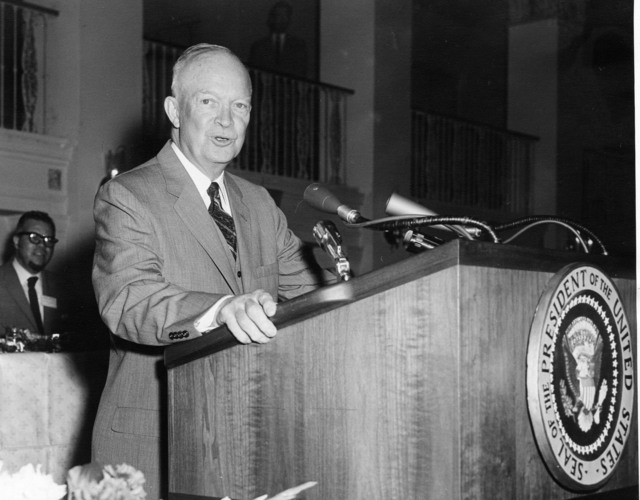
If we set aside Abraham Lincoln’s Gettysburg Address, one of the greatest ever political speeches, there are not many other orations by US presidents that repay careful rereading decades after they were made. But the farewell address by Dwight D Eisenhower in 1961 is one of them.
Eisenhower had completed two terms but his final speech was, like Lincoln’s landmark address, brief, lasting a mere 10 minutes.
An undistinguished West Point graduate, the overall Allied commander on D-Day, a Republican deeply committed to America’s imperial destiny, Eisenhower nevertheless used his last public address to warn of the rise of what he called the military-industrial complex.
It’s a phrase that has stuck as a description of the interpenetration of government, the military, and the arms industry. Perhaps the most important reason why it has resonated is because it has become more relevant in the decades since Eisenhower first coined it.
Eisenhower saw the new “permanent armaments industry of vast proportions” as a danger, if in his mind, a necessary one.
He noted that there were in 1961 “three-and-a-half-million men and women are directly engaged in the defence establishment” and that the US annual defence budget was “more than the net income of all United States corporations”.
The influence of this “immense military establishment” was ‘felt in every city, every state house, every office of the federal government” and affected “the very structure of our society”. This meant “the potential for the disastrous rise of misplaced power exists and will persist” and that such power could “endanger our liberties or democratic processes”.
One of the ways this could happen, Eisenhower predicted, was through “the sweeping changes in our industrial-military posture” brought about by “the technological revolution”.
This made the role of the state much more important: “A government contract becomes virtually a substitute for intellectual curiosity … The prospect of domination of the nation’s scholars by federal employment, project allocations and the power of money is ever present and is gravely to be regarded.”
In the years since Eisenhower’s speech, the Cold War has come and gone, and for a while the weight of the military-industrial complex in society declined.
Today, there are probably something like three to four million people in the US involved in the defence and security industry, a decline relative to the population as a whole. But the technological advance Eisenhower spoke about means that the military, literally, gets many more bangs per buck than it did in 1961.
What is truly frightening, however, is that as the 50% increase in arms spending announced by Donald Trump takes effect, the size of the military-industrial complex will exceed that in Eisenhower’s day, with five million directly employed in defence and security.
The footprint of this will be vastly increased by the technological advances in armaments and security that have already taken place and, with AI, are likely to continue.
It will be the same picture in the UK if the Government’s ambition to continue increasing arms spending to meet the Nato target of 5% of GDP by the end of the decade is realised. That would enlarge the UK arms industry to a size comparable to that at the peak of the Cold War.
As worrying is the growing connection between politics and business. The fusing of governmental, military and corporate elites, always close, is getting even more extreme as the drive to rearmament takes hold in Europe.
It is, predictably, difficult to get an accurate picture of exactly how fast the revolving door between government, military and the arms industry is spinning. But the most substantial picture comes from Freedom of Information requests lodged by The Guardian a while back.
These revealed that an astounding 3572 jobs in arms companies had been approved for former senior military officers and Ministry of Defence (MoD) officials between 1996 and 2012.
More recently, a 2024 study reported that since the mid-1990s, people moving from government into the arms industry included five defence secretaries, six junior defence ministers, four chiefs of the defence staff, two MoD permanent secretaries, three heads of defence procurement and two national security advisers.
The 99-page report for the World Peace Foundation analysed the most senior military and civilian personnel leaving the MoD between 2010 and 2020. It found that more than 40% moved into roles in the arms or security industries, including more than 50% of top military officers and a clear majority of those personnel working most closely with the arms industry in procurement roles.
Prominent among the “revolvers” are three former chiefs of the defence staff, Lord David Richards (in post 2010-13), Lord Nick Houghton (2013-16) and Sir Nick Carter (2018-2021).
Richards went to US arms and security company DynCorp, which Human Rights Watch says was involved in trafficking of women and girls in Bosnia and Herzegovina. He also advises the Gulf dictatorship the United Arab Emirates.
Houghton went on to chair Defence Holdings, whose stock rose 18% in a single day after it was awarded a government contract worth more than £250,000.
Carter became an adviser to German arms firm Helsing. The Parliamentary Oversight Committee imposed restrictions on what he could reveal to his new employers.
There is a similar relationship between government and the media, and it shapes the media landscape. Nearly 60% of retired senior British military officers now working in the defence industry have appeared as expert commentators in UK media without any disclosure of their commercial ties, according to a Declassified UK report.
Some 33 retired officers currently or recently working in defence and security had also been cited in the British press. Some 58% of these were quoted without their paid-for military-industrial roles being disclosed to audiences.
Eisenhower’s fears are, once again, our realities. An even older authority made a similar point. During the English Civil War of the 17th century, republican MP Henry Marten warned Charles I: “If his majesty listens to his armourers, we shall never have peace.”
We should heed the warnings and act accordingly.
Source: The National