
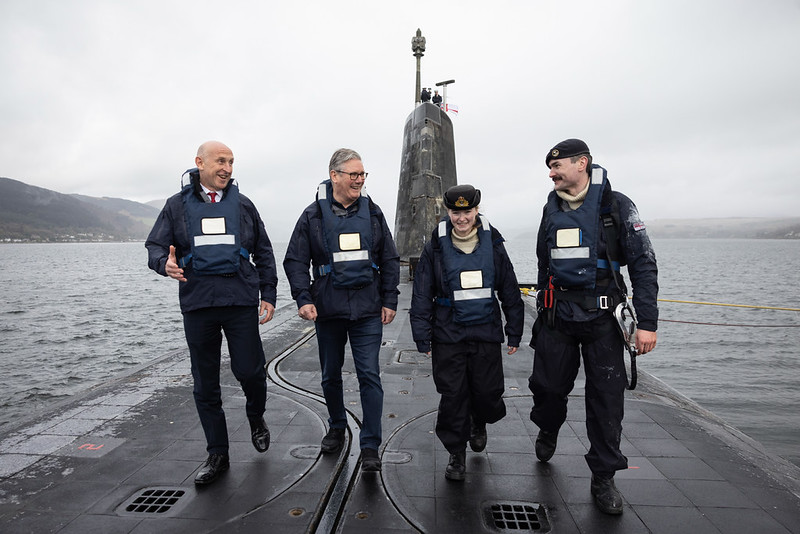
Simon Dawson / No 10 Downing Street
John Healey’s resignation as Defence Secretary lays bare the crisis affecting British imperialism and its determination to play a global military role, involving massive increases in arms spending, after eighteen years of economic stagnation.
Healey has been a leading spokesman for a ‘global Britain’ strategy for the British military. He inherited, and championed, a military strategy oriented around not national defence but global interventionism, generally as a subordinate partner to the USA.
Thus he sent one of Britain’s two aircraft carriers to Japan, pushed ahead the AUKUS military pact and maintained bases in the Middle East, all projecting a worldwide role for Britain, as if the sun had indeed not set on the British Empire.
He secured a huge uplift in military spending to underpin these ambitions, although it may be that pressure from Donald Trump was more decisive. Britain’s overseas aid budget was collateral damage, being eviscerated to pay for the increase to 2.6 per cent of GDP, a rise of 0.5 per cent.
But he wanted more. His resignation letter reveals what for. Key items include leading a naval task force to patrol the Strait of Hormuz, a waterway which was open to everyone before the disastrous US-Israeli attack on Iran, with British complicity. This is a ‘me too’ exercise designed to keep Britain a player in the Middle East.
Another listed by Healey is preparing to deploy an expeditionary force, in concert with France, to Ukraine, although such a plan complicates efforts to bring the war there to an end, and would be a provocation likely to trigger fresh conflict down the line. This is consistent with years of British belligerence around the issue. To be fair to Healey, these are commitments eagerly entered into by Keir Starmer, who clearly likes to talk big at international summits of the western powers and posture as leader of world power.
But it is still not enough for Healey, who wants three per cent of GDP by the end of this parliament to play with.
He sees the hand of Russia everywhere, and claims that the swollen arms budget is needed to deter Moscow, notwithstanding that he also proselytises for Britain’s nuclear weapons system on the grounds that it deters Russia. How Russia, bogged down in Ukraine after suffering enormous casualties, could threaten Britain is unexplained, never mind the ‘why’.
However, the outgoing Defence Secretary’s aspirations collide with the realities of the other traditional centre of British imperial strength – the City of London. At the height of British power in the 19th century, it rested on the international role of the City as much as that of the Royal Navy.
The City, representing international capitalist finance, has been skittish about the state’s budgetary position for some time. It has been pushing up the government’s borrowing costs and is reluctant to endorse any additional unfunded expenditures. Rachel Reeves has embraced the traditional Chancellor’s role as the spokesperson for the City in Cabinet.
Reeves and Starmer have made commitments, which they repeatedly describe as ‘iron-clad’, not to raise those taxes which constitute the main sources of state revenue and to stick within the Treasury’s City-inspired debt-management rules.
Obliging both these constituencies at a time of austerity – the militarists and the money – is a recipe for social crisis. This year we mark the 100th anniversary of the General Strike, caused in large part by the then-government determining to return to the gold standard to oblige the City while maintaining British imperialism’s bloated range of colonial and neo-colonial holdings. The circle was (partially) squared by an attack on miners’ hours and wages.
That is where the third option, the one advanced by Healey’s predecessors as Labour defence secretaries George Robertson and Goeff Hoon as well as Tony Blair, comes in: an attack on working people, generally using the code ‘welfare reform’.
Starmer tried to oblige Healey by going down that route, squeezing other government departmental budgets to secure funds for fighters, warships, missiles, drones and more. But it is insufficient without a broader attack on working people who have already faced a generation of wage stagnation and austerity in public services, since the 2008 crash.
The Treasury acknowledged this in a hypocritical way after Healey’s departure. “Let us be clear what John wants,” a Treasury source was reported as saying, “cuts in schools and hospitals.”
That is indeed where this ends up, but Reeves’ spokesperson is being demagogic for political advantage. What Reeves actually does not want to do is raise taxes on business and wealth, or scare the City by increasing debt. Cuts she could live with, judging by her record.
However, Starmer has faced stern opposition within and without parliament to making workers bear the brunt of the arms drive. Labour MPs rebelled in sufficient numbers against his cuts to disability benefits last year to force them to be withdrawn, for the time being at least. Likewise, he had to reverse the cut to winter fuel benefit after its politically-toxic nature became patent.
The TUC has, thanks in large part to the anti-war movement, reversed its misconceived support for higher arms spending, agreed in 2022. It has determined to put wages and welfare first. The Labour government presently lacks the political authority to embark on that assault on ordinary people which satisfying both the military and the City requires.
Of course, it may be a somewhat different Labour government before long. Andy Burnham has reversed his brief suggestion of standing up to the bond market, and at one time floated the idea of special funding arrangements precisely to finance the arms build-up. It would be unwise to anticipate a new approach there. But standing noisily in the wings are the Reform and Restore parties, led by aggressively authoritarian champions of the City. They are the most likely champions of the Blair-Healey agenda; preparing Britain for great power war by an attack on working people at home.
Not for the first time, fascism and war advance arm-in-arm. The anti-war movement, gathering internationally in London on June 20, is at the core of the forces standing athwart them.