
Last month Ian Murray, the media minister, published a Green Paper proposing to force social media firms to prioritise “trustworthy news providers” so that they can “shape informed public debate.” He claimed that social media is an “existential problem for our democracy” but made no attempt to explain why so many people are turning to it for news.
If the government genuinely wants informed public debate, they might like to encourage the providers they consider “trustworthy” to clean up their act – especially after a month in which they have been banging the drum for more arms spending with a chilling unanimity that reminds me of the build up to the invasion of Iraq. On that occasion, what “trustworthy” news providers fed us turned out to be completely untrue. This time we already have evidence of their dishonesty in it now being admitted that the sabotage of the Nord Stream pipelines was a Ukrainian operation not a Russian one, as most of the media had originally suggested.
Trust could not be more important when it comes to matters of war and peace. Yet legacy media routinely interviews people who stand to gain personally from what they are advocating without telling us whose interests they really represent. The last few weeks have seen lobbyist after lobbyist given platforms to argue that even the eyewatering amounts the government already plans to spend on arms won’t be enough to stop, as one put it, Russians “stomping down your streets shooting children.”
That was the lurid language used by Admiral Lord Alan West on Good Morning Britainon June 12 as he tried to scare viewers into accepting that what he patronisingly called “nice spending” for breakfasts for children would have to be sacrificed to buy more weapons. Good Morning Britain chose to bill West only as a former admiral and not mention that he is on the advisory board of a major military supplier, Kraken Technology Group, along with Donald Trump’s former secretary of state, Mike Pompeo, and the appropriately-named Jonathan Moneymaker, who is also chairman of Kongsberg Defence & Aerospace, a Norwegian-owned company that produces anti-ship missiles and space weapons.
Kraken’s speciality is “uncrewed surface and subsurface vessel technologies to enhance maritime capabilities for US special operations forces.” In a recent statement, it says that it has “firmly established its footprint in Europe, successfully completing NATO’s Task Force, attracting simultaneous funding from the NATO Innovation Fund and the British Business Bank’s National Security Strategic Investment Fund; fulfilling large-scale orders across Europe’s NATO countries; and successfully integrating with the UK Ministry of Defence.”
West’s appearance on breakfast TV wasn’t his only attempt last month to put pressure on the government to ramp up arms spending. On June 8, he made a widely reported speech in the House of Lords claiming that Britain’s armed forces were “teetering on the brink of disaster.” And, in an interview on Radio Four last week, he embellished his fear-mongering by suggesting that failure to spend more on arms would result in “Russian Chechen stormtroopers coming down the street raping women.”
West was only one of the many arms lobbyists who were busy in June. With the government’s Defence Investment Plan (DIP) about to be announced, they were so ubiquitous I thought I would trawl through the overage to see how often “trusted” news outlets told their audiences who they really were. The answer so far is ‘never.’ Without exception, lobbyists were presented as “experts” without us being told they have a vested interest in more arms spending. Here are four more examples.
Admiral Sir Tony Radakin
Radakin retired from his role as the UK’s chief of defence staff only last September, but he was soon snaffled up by the world’s largest bank, J P Morgan, to join their advisory council. In reporting his appointment in April, European Business Magazineput it in the context of an “expansion of (the bank’s) ten-year, $1.5 trillion Security and Resiliency Initiative (SRI) across Europe and the United Kingdom.” It said:
“(This) is JPMorgan placing the balance sheet of the world’s largest bank behind a structural bet that European rearmament, energy independence, and supply-chain reshoring will absorb trillions of private capital over the next decade.”
Radakin being complicit in this lucrative “bet” did not, however, deter “trustworthy” media from inviting him to tell us how much to gamble – without mentioning his conflict of interest. On June 28, when asked by the BBC’s Laura Kuenssberg what advice he would give Andy Burnham, the admiral-turned-US-banker not surprisingly said he had to show that he was “a strong ally of the United States.”
Lord Hutton
John Hutton, the former Labour MP (1992-2010) and defence secretary (2027-28), was frequently in the media in June, including writing for City AM and appearing on LBC(twice), Times Radio and Kuenssberg. None of them mentioned that he is a board director of Pearson Engineering, which manufactures military vehicles and is a subsidiary of Israeli government owned Rafael Advanced Defense Systems.
Commenting in February on Rafael’s 2025 performance, its chairman, Dr Yuval Steinitz, a former Israeli intelligence minister, said:
“We are publishing these results in the midst of a decisive war against an enemy that seeks our destruction. The past year and Operation Rising Lion in particular has once again underscored the critical importance of technological superiority to Israel’s security. Rafael’s advanced systems continued to play a central role in Israel’s most complex defense missions.”
Rafael had a record year in 2025 with sales surpassing $6 billion for the first time. As well as supplying Israeli forces attacking Iran and occupying the West Bank, Gaza, southern Lebanon and Syria, Rafael is a major supplier of military hardware to Germany and the UK and stands to gain massively from increased arms spending in Europe.
Hutton, who supported the Iraq war and has consistently voted for deploying British forces overseas, complained on Times Radio (June 30) that Starmer’s increases in arms spending were not sufficient to get Britain’s armed forces “war ready” by the end of this parliament. On LBC (June 11), Hutton accused Starmer of failing to keep the country safe and called his defence policy a “car crash.”
Lord Dannatt
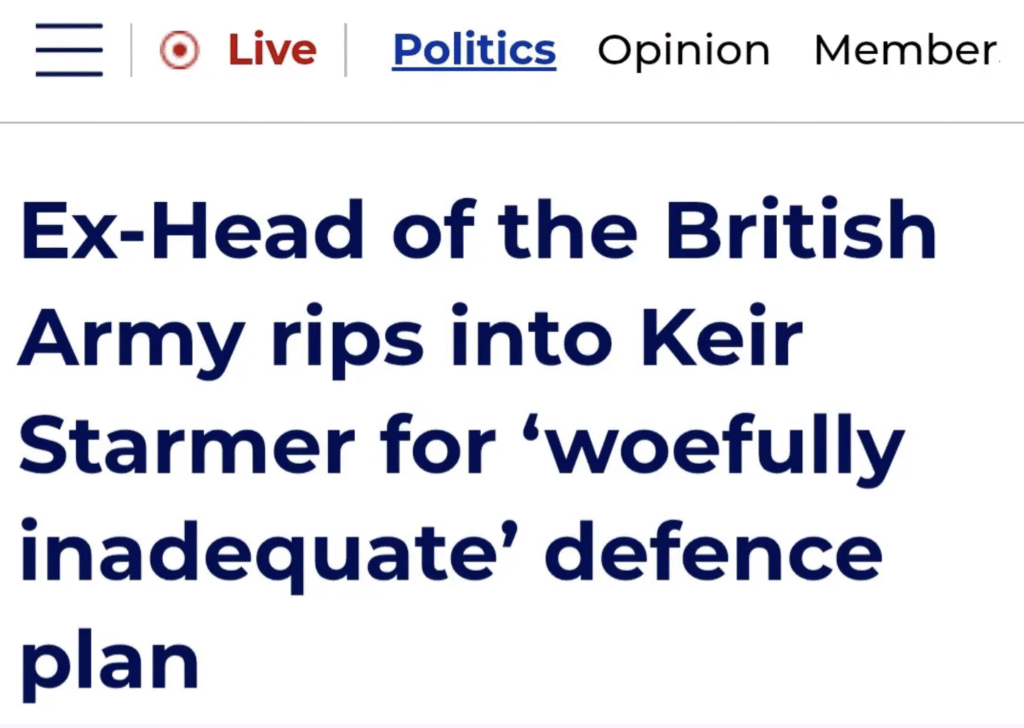
General Dannatt, who was head of the British army from 2006 to 2009 and made a life peer by David Cameron in 2011, completed a four-month suspension from the House of Lords in April for “providing parliamentary services in return for reward.” Dannatt’s paid lobbying, which was exposed last year by the Guardian, included making representation for Teledyne FLIR, a US company that produces components for the F-35 jets used in Israeli airstrikes. As a paid member of Teledyne FLIR’s international advisory group, Dannatt had written to government ministers several times urging them to ensure that the security services “address the threat” posed by Palestine Action, which had targeted the company for facilitating genocide in Gaza.
On June 30, GB News and Good Morning Britain both gave Dannatt a platform without mentioning his lobbying role or suspension. On GB News, he attacked Starmer’s defence investment plan for “not providing the quantum of increase that our nation demands and our allies are calling for.”
James Rogers/Council on Geo-strategy
Dannatt’s suspension illustrates why the military-industrial complex has also created organisations that masquerade as independent think-tanks to do their lobbying. An example of this is the Council on Geo-Strategy, co-founded in 2021 by James Rogers and Viktorija Starych-Samuolienė, who worked together at the Henry Jackson Society, named after the US senator who opposed détente with Soviet Union during the Cold War. The Council on Geo-strategy is mainly funded by the arms industry, including big donations from Lockheed Martin UK and BAE Systems, but, when Rogers wrote for LBC and the iPaper in June to argue for even higher military spending, he was billed as an expert from a ’think-tank’ not as a lobbyist. As an aside, the Council on Geo-strategy has at least provided a suitable home for the journalist-turned-warmonger, Paul Mason, who is now one of their ‘Adjunct Fellows.’
There is no law against ex ministers, generals, admirals, journalists or anyone else selling their expertise to the arms industry. But legacy media should not be platforming lobbyists without telling their audiences of the vested interests they represent and then treating them with reverence as if they are impartial experts. On what planet is this how a trustworthy news source should operate?
Making sense of the numbers
For those not clear how much we’re spending the table below shows the figures for four years from the 81-page DIP document. RDEL is ‘resource’ spending or the running cost of the military, and CDEL is ‘capital’ spending or the cost of buying missiles, drones, warheads and other assets from the arms industry. The four-year total (TDEL) of £297.7 billion is £15 billion more than was announced by Rachel Reeves in the last Budget, which was itself taking spending on an upward trajectory. The military budget in 2029-30 will now be £79.1bn compared to £53.9bn in 2023-24.
To put this in context, the total military capital spending (CDEL) over the four-year period of £125bn is more than twice what will be spent on health and social care capital (£57.8bn) and four times as much as allocated for education (£31.4bn).
The arms lobbyists are still saying this isn’t enough. And the media are framing the debate as being between their view and the astronomical sums in the Starmer-Reeves plan. They give virtually no platform to those who would argue against the military madness and for more resources to be invested in trying to prevent or end wars. The challenge for us is to break that wall of silence – and the international anti-war conference in London last month shows that what we lack in power, money and access to ‘trustworthy’ media, we make up for in numbers, unity and spirit.
Source: Substack