
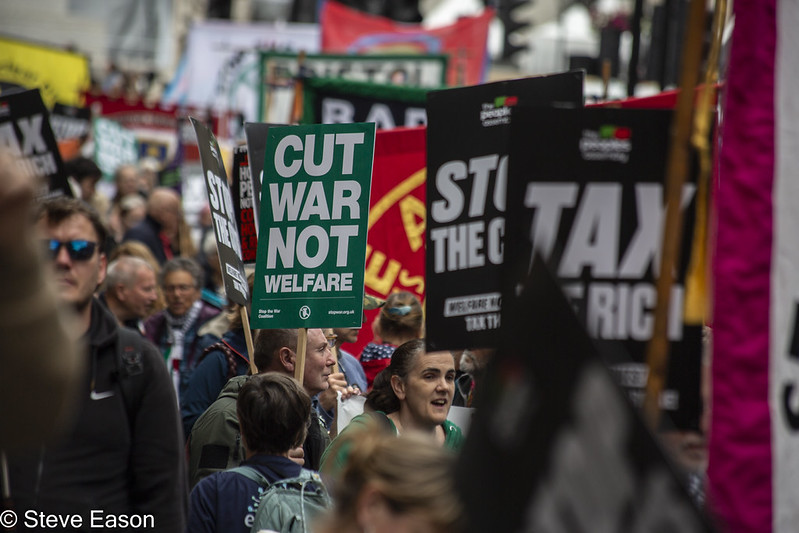
In a telling and desperate bid to leave ‘a legacy’ Keir Starmer is insisting on announcing Britain’s Defence Investment Plan before he leaves office. Never mind the cost-of-living crisis or the collapsing services he leaves behind, Starmer wants to be remembered as the man who ramped up spending on weapons.
The announcement will be made tomorrow [30 June], in plenty of timebefore the NATO summit that starts in Ankara on 8 July.
John Healey resigned as minister of defence on 11 July this year, because he believed that Starmer’s plan to increase defence spending by £13.5 billion wasn’t good enough. Ironically, it was Healey’s move that sealed Starmer’s fate.
Despite statements from Starmer’s office that he wouldn’t give in to pressure, Healey’s successor Dan Jarvis has in fact gained an extra £1 to £1.5 billion from Starmer. Britain is already committed to spending 3.5% of GDP on defence by 2030, which will mean an increase of £35 billion from where we are now. That increase is more than the total spend of the Home Office and the Justice ministry put together. Andy Burnham has agreed to these plans.
This is an indication of the huge momentum there is behind rearmament. European countries are currently increasing arms spending by an average of 20% year on year. Germany raised its defence spending by a shocking 50% last year. As we heard at the international anti-war conference on 20 June there are moves across the continent that amount to the militarising of society. Ten countries already have conscription in Europe.
The given reason behind this war fever is the alleged threat from Russia. This is just not plausible. Russia is a regional power, not a global one. Its economy is a little bigger than Spain’s and a little smaller than Italy’s. It is bogged down in a brutal, stalemated war with Ukraine. If it has been unable to reach Kiev, it is hardly a threat to Paris, Berlin or London.
Any minimally objective observer would conclude that the great threat to the world peace comes from the country that is bombing Iran, has backed Israel throughout the genocide, forcibly removed the Venezuelan President, blockaded Cuba and threatened Greenland and Canada with invasion.
But that is not how our rulers see it, They are enthusiastic backers of the war in Ukraine because they want to discipline Russia and they have done everything possible to prolong the carnage in the hope this can happen. But this is not because Russia is a wider military threat, it is a question of the European powers’ wider position in the world.
The drive to rearm is in fact not mainly about Russia, but about Europe’s relationship with the US. It is a function above all of anxiety that Europe will be sidelined by the US as its attitude to NATO and its traditional allies has changed under Trump. European governments’ aim is to prove their indispensability to the US, but also in a worse case scenario to be ready to fight as a collective interventionist power in their own right. Whatever we may think of plausibility of that project, we should have no doubt that they are serious about the effort.
The war drive served other purposes. It is seen in some circles – with little evidence – as a way to boost the economy and it will of course benefit the influential arms sector. It is also a convenient way to justify further cuts in services which were until recently being defended in terms of balancing the books. It is helpful too in the task of trying to suppress the anti-war and pro-Palestine left.
Security, defence and the fantasy threat from Russia are now the main ways that the ruling classes are justifying attacks on social programmes, on welfare and working class living standards in general.
Precisely because of this, any effective campaign against the cuts needs to be making anti-war arguments. The reverse is also true; the anti-war movement needs to be pointing out these connections and putting class arguments at its heart. There is strong minority opposition to any increase in defence spending, but polls show this opposition surges to big majorities across Europe when it is presented as a question of choices between wages and weapons, between welfare and warfare.
It is urgent that we build a popular movement that has these arguments at its heart.