
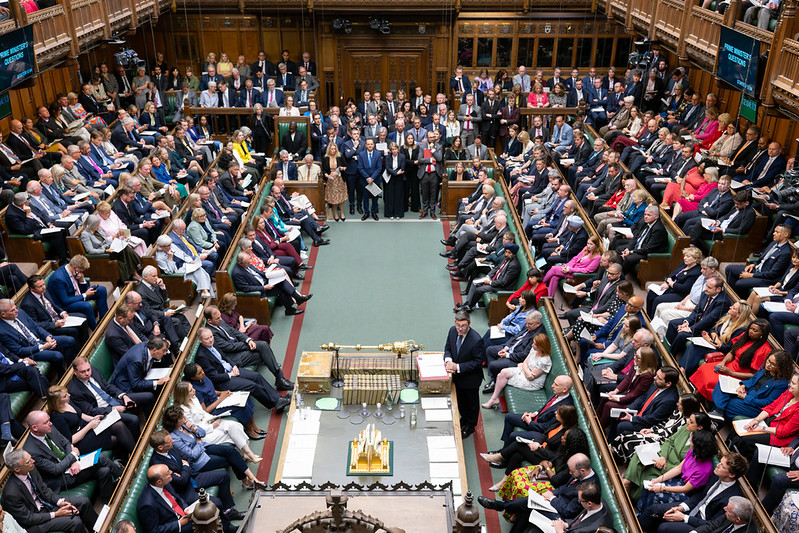
MPs have returned to the Commons after a seven-week break. What will they be talking about after their holidays?
If they were taking the job as seriously as they should there would be only one topic at the top of their agenda – the growing danger of war; specifically, the possibility, escalating from day to day, of armed conflict between this country and Russia.
The Russian government has publicly warned that Britain is “playing with fire” over its deepening involvement in the war in Ukraine.
It has expressly indicated that it regarded British military facilities in Ukraine as legitimate targets for attack.
What such facilities amount to, and why, is not something the British government has been forthcoming about, although the revelation scarcely comes as a surprise.
Maria Zakharova, Russian Foreign Ministry spokeswoman, told reporters: “We have repeatedly warned that any British military installations and equipment in Ukraine and beyond its borders could be targeted in response to Ukrainian strikes on Russian territory carried out using British weapons.”
Key words there: “and beyond its borders.”
In response, the British government seems to have scarcely taken the threat seriously. It has occasioned little more than a reassertion of habitual knee-jerk bombast along the lines of a refusal to be cowed etc.
“We propose that the British leadership once again carefully analyse the situation and immediately, in the most resolute and unequivocal manner, abandon the hostile, aggressive line,” Ms Zakharova suggested.
Andy Burnham seems as little disposed as his predecessors from Boris Johnson onwards to act on this advice. Careful analysis of the matter has been at a premium in Whitehall since the outbreak of the Ukraine war in 2022.
Now it is true that the Russian government has made alarming threats before in the course of this conflict, including of the possible use of nuclear weapons. Its rhetoric has moved in inverse proportion to its military accomplishments.
Let one just note in passing that in this matter as in many others, the Putin government is very different from Soviet power. The latter tended to eschew bombastic pronouncements and let the might of the Red Army speak for itself.
Be that as it may, it seems the height of foolishness to assume that Zakharova is simply blowing hot air. Her statement was accompanied by the departure of Russia’s ambassador to London, with no replacement in sight.
It should also be noted that no such categorical threats have been made against France or Germany, let alone the United States.
The truth is that the British government has placed itself in an exposed position thanks to its increasingly aggressive intervention in the Russia-Ukraine war.
From the first, it has spared no effort to prolong the war – Boris Johnson stopped partying in Downing Street long enough to fly to Kiev in April 2022 to help block an incipient peace deal.
Starmer sought to trip up Donald Trumps’s faltering attempts to end the war by bringing together a “coalition of the willing” to keep Ukraine in the fight if US support faltered.
His big idea was deploying British and French forces to Ukraine to police any ceasefire, an obvious deal-breaker since it would effectively extend Nato power up to Russia’s Ukrainian border.
Moscow has made it plain that such expansion by Nato is the greatest single cause of the conflict. Peace on such terms is, as Whitehall well knows, an impossibility.
As Starmer, so Burnham. Not only has the new premier signed up to the eye-watering military budgets embraced by the old one, his first overseas trip was to Ukraine to pledge backing to the beleaguered Zelensky.
MPs should at least be asking why this bipartisan anti-Russian policy is being maintained despite the very evident risks and expenses in which it is embroiling the country.
After all, the territories which are disputed between Russia and Ukraine are all lands ruled by Moscow from the 18th century onwards, without vital British interests being compromised or impeded thereby.
That is not to say that the regions contested should be disposed of in defiance of their populations’ wishes, but it would seem that one decision or another would leave the British establishment pretty much where it is, and with more pressing concerns to worry about.
It is argued, and the point can scarcely be disputed, that in his actions of February 2022 Putin placed Russia in breach of international law.
Yet that can hardly be a supervening consideration for governments like the British which have blandly endorsed, when not actively assisting, Israel’s genocidal illegalities in the occupied territories; which shrugged when Donald Trump kidnapped the Venezuelan head of state and has quietly backed his lawless aggression against Iran without demur.
Of course, official London is deeply invested in trying to maintain the now-tattered world order established by Washington in the wake of the Cold War. The City of London has profited mightily from that order, and no British government has been able, nor even attempted, to wean itself off the imperatives of finance capital.
Even as the post-1991 arrangements disintegrate into sharpening great-power conflicts, trade wars and arms races, Britain seems determined to keep as much of them as possible extant.
Thus it is a clear objective to bleed Russia as much as possible, if only to render it incapable of further military initiatives in that looming gap when Europe has not armed itself sufficiently to make good the possible, even likely, future absence of the US from the balance.
There is no serious sign of Moscow contemplating further military adventures, but the pretence is a profitable one for the arms monopolies and necessary to develop a war psychosis at large.
Beyond that looms confrontation with China, the most obvious challenge to the world as the City thinks it should be ordered.
So peace must be forever postponed, whatever the mounting cost in Ukrainian and Russian lives. If Russia cannot be defeated – still an unlikely contingency, despite Ukraine’s recent drone-facilitated successes – then a bloody deadlock seems to suit official London fine.
There is no sign of any British government at any point as much as entertaining a thought as to the obvious alternative – a ceasefire, an eventual peace settlement between the two principal parties on a democratic basis and ultimately a common Europe-wide security architecture which could address the concerns of all.
In short, British diplomacy has entirely absented itself from the field, replacing policy with vaporous clouds of propaganda posturing designed to make a bad situation still worse.
Except there is a line somewhere which, if crossed, will make Britain a direct participant in the war. We do not know where that line is but Burnham, with his pledge to provide missile technology to Ukraine, has surely taken a significant further step towards it.
We will know we are over the line when Russian missiles fall on British military facilities established where they have no business being and military confrontation escalates unpredictably – and unpredictability is a feature of the age of Trump – from there.
There is no necessary reason to believe that the British people themselves will be spared the consequences and every good reason to assume that for British imperialism that is an incidental consideration.
Is this being debated? Is public opinion remotely alert to the dangers? Are MPs speaking out?
We know the answers alas. It falls to the anti-war movement to point to the gathering clouds. Waiting for the Archduke’s driver to attempt his fateful U-turn in Sarajevo will surely be too late.
Source: Morning Star