
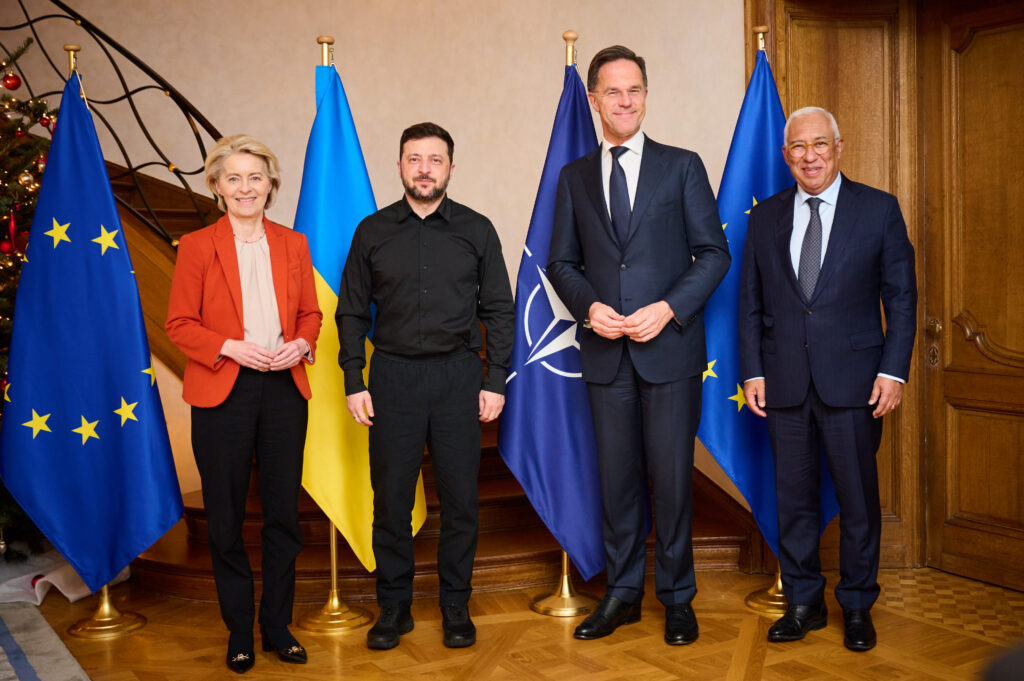
Ursula von der Leyen, Volodymyr Zelensky, Mark Rutte and António Costa
Ukraine has been at the epicentre of European politics since Russia launched its war of aggression in February 2022.
Few expected it to survive the onslaught, let alone still be fighting in 2026, but the conflict quickly turned into a long proxy war between the collective West and Russia.
Impressed by Ukraine’s resistance, the West increased military and financial assistance to bleed its geopolitical rival. Moscow was quickly forced to the negotiating table in spring 2022.
The draft agreement reached between negotiators from Ukraine and Russia in April 2022 met several key Russian demands, including Ukrainian neutrality and limits on its armed forces, while recognising Ukraine’s right to join the EU.
Yet the then prime minister Boris Johnson’s visit to Kyiv in those critical days appears to have encouraged Zelenskyy to abandon the negotiations. Ukraine’s elites put a wager on continuing the war, hopeful that both Western assistance and domestic cohesion would persist. At first, their choice appeared shrewd, as a lightning Ukrainian counter-offensive liberated vast swathes of territory in autumn 2022.
Nonetheless, Ukraine’s wager on continuing the war was a major strategic mistake. The Russian military fortified its positions in eastern Ukraine and successfully repelled Ukraine’s much-vaunted offensive in summer 2023.
While there have been headline-grabbing successes for Ukraine since then – like its short-lived incursion in Russia’s Kursk region in 2024-25 – Russia has slowly advanced ever since, and now controls around a fifth of Ukraine’s pre-war territory.
As the costs of war mounted, support weakened in the West, facilitating the rise of politicians such as Donald Trump who promised negotiations. Aid to Ukraine from the US has slowed under Trump, falling further behind Europe. By early 2026, US aid totalled $135 billion, compared with $235bn from European nations, according to the Kiel Institute for the World Economy.
Polling this spring showed that three-quarters of Ukrainians and more than two-thirds of Russians now favoured negotiations rather than fighting until military victory.
Despite this convergence, the costs of continuing the war have been profoundly unequal. Russia’s economy has slowed sharply, according to its central bank, with projected growth of just 0-1% in 2026, but Putin’s approval rating fell only slightly from 70.4% to 66.9% in June. Public opposition to the war and the Kremlin remains muted.
Ukraine, by contrast, has borne far higher costs because the war is being fought largely on its territory. The human toll has been immense.
The Centre for Strategic and International Studies estimates that Russian losses have outnumbered Ukrainian deaths by a ratio of up to 2.5-1. But Russia’s pre-war population was three times larger than Ukraine’s.
Now, Ukraine faces a demographic catastrophe, resulting from emigration, territorial losses and falling birth rates. Ukraine’s Institute of Demography estimates that only around 29 million of its 41m pre-war population remains on territory controlled by Kyiv.
Worse still, the country records 12,000 births per month, compared with 23,000 before the invasion.
Furthermore, Ukrainian sociologist Volodymyr Ishchenko argues that the Ukrainian state responded to the war by intensifying regressive neoliberal policies. Inequality has risen, while high-level corruption remains rife.
The outlook for ordinary people is bleak, reflected in high draft evasion and desertion rates, plaguing not just military planners, but societal cohesion. Rioting broke out against heavy-handed draft officials in Lviv in early July.
Ukraine’s mobilisation crisis has also shaped divisions within the leadership and the country at large. Demonstrations followed the sacking of defence minister Mykhailo Fedorov, who argued that drones and advanced technologies could offset manpower shortages and save lives. Indeed, protesters successfully forced the sacking of the unpopular commander-in-chief Oleksandr Syrskyi because of his reputation for defending territory at the expense of devastating losses.
But the reality is that, although Fedorov’s technology-centred strategy slowed Russian advances and raised Moscow’s costs, it failed to turn the tide. Meanwhile, Russia’s ballistic missile strikes continue to batter Ukraine’s energy sector and export capacity, leaving Zelenskyy scrambling for even more Western military and diplomatic support.
Militarily speaking, Ukraine’s manpower shortage and its dependence on Western aid help explain Zelenskyy’s recent policy contradictions.
Source: The National