
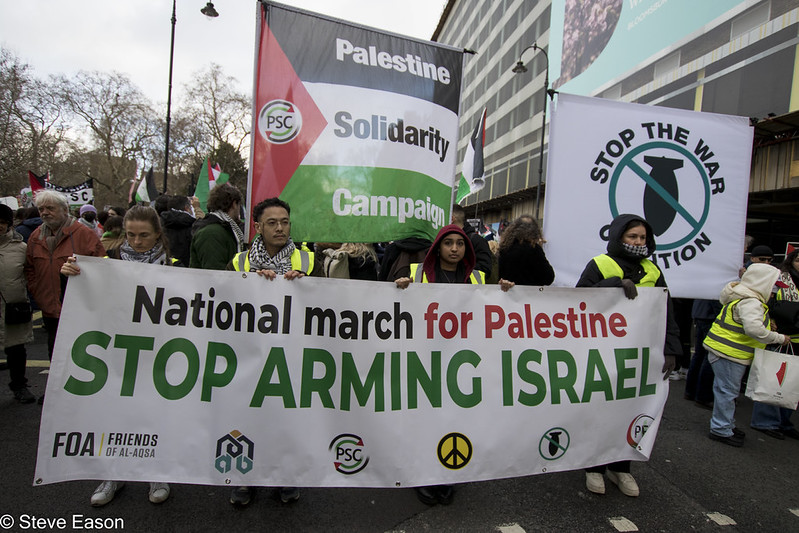
Keir Starmer, in a speech to the nation following the horrific attacks on two Jewish men in London’s Golders Green, signalled the opening of a concerted state campaign against the anti-war movement and political dissent.
In his address, the Prime Minister squarely took aim at the national Palestine solidarity marches. Setting the scene for a further increase in police powers, these marches, he suggested, have caused a rise in antisemitic hate crimes.
Earlier that day, the Government’s reviewer of terrorism legislation, Jonathan Hall, repeated his call for a ‘moratorium’ on Palestine demonstrations following an emergency Cobra meeting with the cabinet and key figures from Britain’s security apparatus. The time had come, he said, for the Government to “take more risks as to what it’s prepared to do”.
Farage said the Government had been “weak, weak, weak” on the demonstrations. Badenoch followed with a call for an outright ban on Palestine protests, claiming “it is quite clear they are used as a cover for promoting violence and intimidation against Jews”.
Pressed by Laura Kuenssberg on whether the march called by far-right thug Tommy Robinson on the same day should also be banned, the response was to insist that the Palestine protests were uniquely illegitimate because they targeted a minority community.
Between Wednesday and Friday last week, some 194 stories in the UK media referred to “hate marches”. These were not in connection with Robinson’s planned provocation, which open fascists are advertising online as a day of intimidation against minorities, but to the Palestine Solidarity marches.
More chilling still were the direct and highly politicised interventions of Mark Rowley, chief of the Metropolitan Police, who in interviews with both The Times and Good Morning Britain made the false and defamatory claim that organisers of the national Palestine demonstrations in London had sought “to walk by synagogues” as if they were a political target.
On its own, the attempt to link the Palestine solidarity demonstrations with the attacks at Golders Green last week is deeply disconcerting. The suggestion that these demonstrations are in any sense antisemitic is a falsehood and amounts to a smear on the millions who have attended them, not least the thousands of Jewish people who march together in a visible bloc.
The claim that the demonstrations set out with an intent to pass synagogues, made by a senior and unelected official of the British state, is an outright lie.
These statements have been firmly challenged by the Palestine Coalition, which has organised 34 national demonstrations in London since October 2023, all of them peaceful, and all focussed on building pressure for a ceasefire and ending arms exports to a state whose leaders are wanted for war crimes by the International Criminal Court.
Most alarming of all is the apparent willingness in parts of the state and political class to use the threat of the far right to intimidate the largest extra-parliamentary movement in the country.
On May 16, the police have granted permission for Robinson’s demonstration to pass through the political centre of London, despite the Palestine Coalition requesting a similar route months earlier.
As the police are well aware, Robinson, who tore up a Palestine flag at his last demonstration, called this march as a direct provocation on a weekend when the movement mobilises every year.
There are precedents for the state’s use of far-right street movements as battering rams against the left. None of them are good.
Taken together, these developments mark new battle lines being drawn by a British establishment united across party lines and co-ordinated with an openly politicised and unaccountable state apparatus.
The Palestine solidarity movement is the central target of these efforts because it has proved itself to be the most effective political opposition to British state policy in recent history.
A genuine mass movement, driven by widely felt anger at Israel’s actions in Gaza and British political and material support for them, it has become a symbol of the disenchantment of millions with traditional political authority. It is bitterly resented across the establishment, from the parties to the police and the media.
And it is feared as a permanent social force demanding that those in the UK Government who are complicit in genocide should be held to account. The attack came a week before elections in which the current administration is set to lose further votes, not least to the left. The media and political set aim to derail Zack Polanski’s surging Green Party, just as they united against Jeremy Corbyn.
Challengers to the status quo are to be punished. In this process, Britain’s monstrous and disastrous foreign policy must be defended against the mass movement against war and for the Palestinians.
The state has judged that the moment has come to intervene and curb the primary source of political dissent in this regard. But we have survived attacks before.
The political establishment have already exposed themselves in relation to Gaza. Try as they might, we will not be deterred from marching, organising and campaigning. That said, the period ahead will demand more from progressive forces, particularly those that seek to challenge British imperialism.
It will demand organisation equal to the scale of the attack, and clarity about what is now being confronted. A crucial struggle for our basic democratic rights and civil liberties is under way.
Our movement is a broad cross-section of society, uniting people across faith and politics against war, racism in all its forms and genocide. The fallacious attacks against it will not stand the test of time.
History will record who opposed the mass murder of the Palestinian people, just as it will those who provided the political cover and the arms to carry this crime against humanity out.
And it is that which condemns the whole British establishment.
Source: The National