
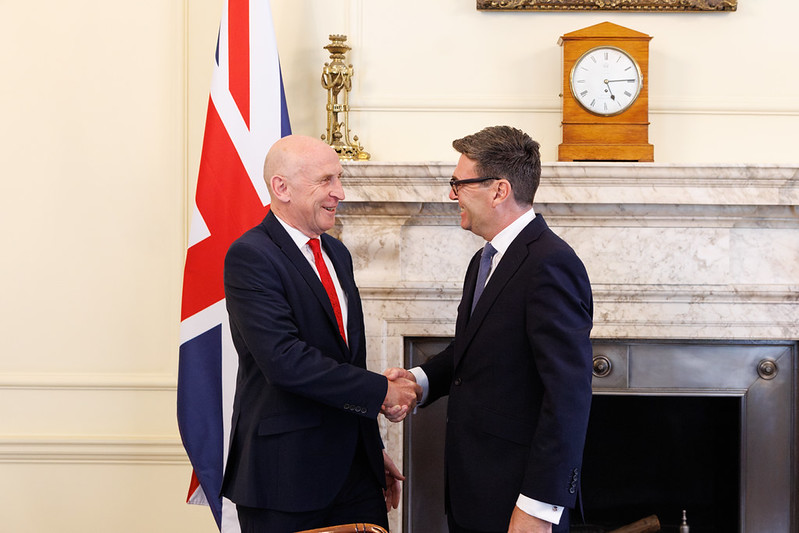
Prime Minister Andy Burnham appoints John Healey as Chancellor. Picture by Simon Dawson
The word ‘chutzpah’, derived from the Yiddish, is defined as ‘supreme self-confidence, nerve, or shameless audacity’. John Healey’s behaviour towards the end of last week was chutzpah at its most shameless and audacious.
Healey, you may recall, is the man of honour who resigned from Keir Starmer’s cabinet. He could not countenance any further delay in the UK committing to spending 3% of GDP on defence by 2030. He was so committed to splurging public money on weapons and war that he could no longer serve a prime minister who prevaricated over the target.
Healey was rewarded for this principled stand – or manipulative undermining of Starmer’s authority to help remove him from office, if you prefer – when he was appointed chancellor by the new prime minister. Andy Burnham’s choice of Healey, together with making Wes Streeting defence secretary, seemed to signal a commitment from Number 10 to driving up military spending – the sooner the better.
Yet all is not going smoothly. Healey has now indicated that the plans for reaching the 3% target will not feature in his autumn budget, scheduled for late October, and will be deferred to next year.
The scale of the prospective increases is huge. The 3% target is itself merely a stepping stone to reaching 3.5% by 2035. This can only be achieved by making savage cuts in other areas of spending.
This is precisely why the Treasury is floundering. The money isn’t there. For all the right-wing myths about bloated benefits bills, the truth is that years of Tory austerity cut public spending to the bone.
It seems unlikely that the government will resort to wealth taxes. Jim O’Neill, a former adviser to Burnham, has publicly warned that increasing capital gains tax would prompt business owners to leave the country. This is familiar rhetoric in defence of the wealthy.
What is also grimly familiar is calls for ‘slashing benefits’. We are seeing a distinct spike in right-wing, establishment pressure to do this. One example is the former director of the Institute for Fiscal Studies, Paul Johnson, urging Burnham to cut Personal Independence Payments – a lifeline to many disabled people.
There has also been a renewal of stories floating the option of abolishing the ‘triple lock’ on state pensions. It is worth mentioning here that Germany is currently reforming state pensions to cut spending, very much in order to fund the new militarism.
There is predictable right-wing media outrage in response to Healey’s climbdown. The Daily Mail’s headline ‘Surrender’ sets the tone. This is supplemented by lurid claims about how Russia could attack Europe, none of which stand up the most basic scrutiny.
The Daily Telegraph warned that the US is looking at ways to punish the British government if it doesn’t hike up military spending rapidly. It is apparently considering opposing British claims of sovereignty to the Falkland Islands. The current Europe-wide drive to increase military spending has been driven by Donald Trump’s insistence that Europe must fund its own ‘national security’.
Even with the 3% target’s postponement, however, there are still big increases in the military to pay for. Healey’s 28 October budget will reportedly focus on spending cuts in order to fund the shortfall in the Defence Investment Plan, which was unveiled in Starmer’s final days as PM. There will be no good options.
What is needed instead is a shift in priorities. Ditch the planned increases – which are both wasteful and dangerous – and focus on investment in public services and infrastructure. Job creation ought to be in climate-friendly industries, not an arms industry that is destructive to the climate and potentially devastating through war.
Source: Counterfire