
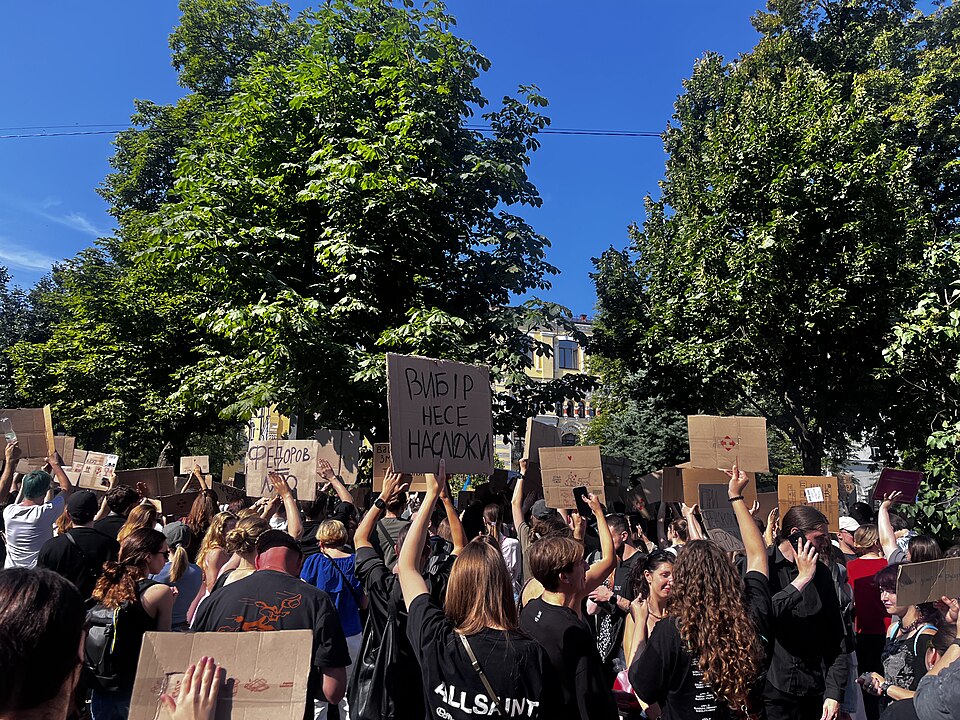
Protests against the dismissal of Mykhailo Fedorov, Kyiv, Ukraine, 16 July 2026
President Zelenskyy finds himself in the midst of a political crisis. Bad enough in times of peace, as I am sure the last run of British prime ministers would agree, even worse when your country is at war, especially when the crisis centres on the military command and results in a week of street protests.
The protests are a serious threat to Zelenskyy’s authority. They have attracted mass support and include soldiers and veterans – so much so that the army issued warnings for active soldiers not to interact with the media, make public statements or join any “political mass events”.
The immediate cause was the sacking of Defence Minister, Mykhailo Fedorov, after only six months in office. He is young (only 35 years old), popular and viewed as the mastermind behind Ukraine’s policy shift to drone warfare. His dismissal sparked street protests which began last week in Kyiv and spread to more than 16 cities. The protests rapidly evolved. Initially they were entirely focussed on Fedorov’s dismissal but within just 24 hours the focus had shifted to criticise military tactics and corruption, and began to question the record of Commander-in-Chief and Zelenzkyy ally Oleksandr Syrskyi.
In an attempt to appease the protestors (and in light of fear expressed by Ukraine’s Western backers as to where the protests might lead) General Syrskyi was removed from office and replaced by Mykailo Drapatyi, a Fedorov ally. Changing military leadership in this way and in the middle of war is a dramatic move and certainly not one that would have been taken lightly. Yet still Zelenskyy is not out of the woods. There has been a call for further demonstrations on Friday (24 July) outside the presidential office in Kyiv, demanding Fedorov be fully reinstated.
The bitter rivalry in Ukraine’s military high command
Ukraine’s former Commander-in-Chief Oleksandr Syrskyi represented the old guard. He is 60 years old and schooled in the military of the former USSR. His approach to military discipline was traditional and top down, his tactics were based on artillery and infantry ground assaults (with all the accompanying casualties), and his military procurement was centralised and open to corruption. His nickname in Ukraine is ‘the butcher’.
Although Syrskyi was the commander responsible for orchestrating the successful counter-offensive in Kharkiv, seen as a huge victory for Ukraine, more recently he has been associated with the defence of Bakhmut, one of the war’s longest battles that killed tens of thousands of people. And with exposure in the media of systemic abuse of recruits in one of his regiments (the Skelia Regiment), reportedly resulting 32 noncombat deaths, Syrskyi’s reputation as a butcher grew and the calls for his dismissal became louder.
Fedorov in contrast is young and charismatic, his background is in the tech industry and he is seen as the mastermind behind the move away from trench warfare towards Ukraine’s tech driven drone approach. He oversaw pay rises and fixed-term contracts for recruits in an attempt to tackle the problem of soldiers going AWOL, and when sacked was in the process of reforming the military procurement system that for years had lent itself to corruption for the personal enrichment of the generals. Fedorov’s reforms included competitive tendering and digital procurement tracking, making backhanders and inflated contracts increasingly difficult to hide. Fedorov is popular and seen as a possible rival to Zelenskyy once the war is over.
Unsurprisingly Fedorov and Syrskyi came to blows in what was described by a Chatham House analyst as a “paralysing internal conflict”. Someone had to go. And Zelenskyy chose that someone to be Fedorov.
By choosing to side with Syrskyi, Zelenskyy clearly prioritised his own political position over ending the war, tackling endemic corruption or saving Ukrainian lives. According to a poll conducted in May this year 67% of Ukrainians believe Zelenskyy will be replaced once the war is over (there can be no elections until the war is over because of martial law). There appears to be a pattern emerging of Zelenskyy sidelining and sacking popular officials before they become potential political rivals. In sacking Fedorov, it appears Zelenskyy attempted to neutralise a political rival, although this time it may have backfired.
The war is increasingly encroaching on civilian lives and civilian casualties are rising sharply. According to the UN the first six months of this year (compared to the same period in 2025) saw a rise by 37% in Ukrainian civilian casualties, in Russia it was by 121%. Drones and long-range ballistic missiles are targeting densely populated urban areas far from the front.
A poll in May showed that the majority of Ukrainians want the war to end, even without ‘victory’ or winning back territory lost to Russia. This war has now raged for longer than either the First or Second World Wars – surely that’s long enough? Rather than doing everything in his power to keep the war going, Zelenskyy needs to recognise his time is up, and his Western backers should do what they can to de-escalate and end this cycle of violence.