
Credit: Simon Dawson / No 10 Downing Str
Anyone reading the front pages of most newspapers the day after the Budget would be forgiven for thinking that a staggering amount of money is going to be spent on lifting the two-child benefit cap while workers are fleeced to pay for it.
They were nearly unanimous in playing the divide and rule card. “Spiteful raids on strivers to lavish billions on Benefit Street,” screamed the Daily Mail. “The Benefits Street Budget – Families will foot handout bill for skivers,” echoed The Sun. “High welfare, high tax,” was the more sedate variation on the same theme from The Times.
Few of them even bothered to mention that the annual cost of abolishing the cap – and lifting more than 600,000 children out of poverty – will be a relatively paltry £2.3 billion in 2026-27. Of total annual tax revenue in 2026-27, it is less than a fifth of one per cent (0.176%).
It’s true that, in extending the freeze on tax thresholds by three years to 2030-31, Reeves has hit workers and pensioners hard, but scrapping the two-child cap is far from being the reason for that. In fact, she could have lifted the cap and not penalised “strivers” at all because the welcome increases in taxes on landlords and betting more than cover it.
So why has she extended the freeze on tax thresholds? At the lower end of the scale, millions more people will pay tax. Meanwhile, better paid workers who get an increase that takes them over the £50,000 mark will see their earnings above that level taxed at 40%. It is hardly a vote winner, but it is what you have to do if you are creating a war economy.
Reeves glossed over the subject. In a 7,000-word speech lasting over an hour, she devoted just two sentences to military spending. And yet the real story – and the main reason for the tax increases on working people – is that this was a war budget.
Is that an exaggeration? Let’s look at the facts. According to the House of Commons Library, military spending peaked in the mid-1980s at the height of the Cold War, then declined in the 1990s before rising sharply under Tony Blair because of the invasions of Iraq and Afghanistan. With those wars abating, it declined briefly and then increased again until it returned to Cold War peak levels in real terms in 2023-24.
With military spending having increased further in 2024-25 and 2025-26, Reeves’s starting point last week was already higher than at the height of NATO’s confrontation with the Soviet Union. Now, she plans to go much further.
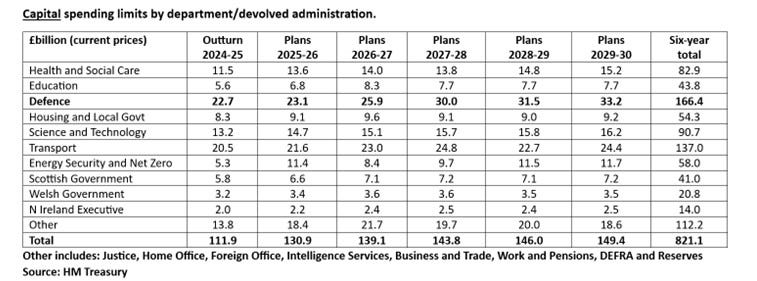
The 152-page document accompanying the Budget shows military spending rising 8.43% to £90 billion in 2026-27, compared to a 6.14% increase for health and the allocation for education shrinking by 0.68%. The 2026-27 arms budget includes £25.9 billion of capital spending, which is a rising proportion of the overall cost. Cumulatively over the six years from 2024-25 to 2029-30 (see table below), capital spending on arms – £166.4 billion – will be nearly quadruple the amount spent on education (£43.8 billion) and double the spending on the NHS and social care (£82.9 billion).
And these figures do not include military support to Ukraine, which comes out of the Treasury Reserve. To date, the UK has already given Ukraine £10.8 billion and Keir Starmer has committed us to continue paying £3 billion a year every year until 2030-31 or “for as long as it is needed.”
None of this is ever properly debated. None of it made the front pages the day after the Budget. British politics suffers from not having a single major political party that will challenge the line that we are not spending enough on ‘defence’, which is being fed to us via the media by ‘intelligence sources’, retired generals and assorted arms lobbyists presented as ‘independent experts’.
It’s never enough for them. And, to justify it, they manufacture scare stories that most people do not have the time to deconstruct. Take the recent one about a “Russian spy ship” being inside “British waters”. The media gave it wall-to-wall coverage. The Guardian’s headline said “Russian spy ship enters British waters” and its report claimed that this was “part of a pattern of Russian incursions into Nato-controlled territory.” The story was based on what was billed brazenly as “a pre-budget speech” by John Healey, the defense secretary, who claimed that it “vindicated the government’s increase in defence spending.”
But did it? Healey chose his words cunningly. He said the ship was “on the edge of UK waters…having entered the UK’s wider waters over the last few weeks.” The distinction is critical. As former diplomat Craig Murray explained in a blog, a country’s ‘wider waters’ extend 200 miles from its coast and are known as its Exclusive Economic Zone because they entitle it to the fisheries and mineral resources in those seas. However, they are not the same as a country’s territorial waters, which extend just twelve miles from its coast and are subject to its laws.
Pointing out that a country’s Exclusive Economic Zone is deemed part of the high seas, Murray said: “There is freedom of navigation on the high seas. Foreign ships, including foreign military ships, may come and go as they please. Nor is there any ban on ‘spying’ – exactly as there is no restriction on spying from satellites.”
British vessels often enter the Exclusive Economic Zones of other states, as Healey well knows. Only two months ago, a Royal Navy frigate, HMS Richmond, accompanied a US guided missile destroyer, USS Higgins, through the straits between China and Taiwan, which are only 81 miles wide at their narrowest point. The operation drew protests from China, but a Pentagon statement said the vessels were beyond China’s territorial waters and that the operation “demonstrates the United States’ commitment to upholding freedom of navigation.”
HMS Richmond is patrolling the Far East as part of a Royal Navy ‘strike group’ led by the aircraft carrier HMS Prince of Wales. You may wonder what that has got to do with Britain’s defence and why we are spending money on it while cutting spending on education. If you do, you will sadly find that only a handful of our MPs are willing to question the costly and dangerous war games of our political leaders.
Long ago, it was possible for Britain to ‘rule the waves’ while boasting of creating a welfare state at home. Today, with the super-profits of imperialism much diminished, our rulers can no longer afford both. They have stigmatised the word ‘welfare’ while preparing us for warfare. The Budget underlines the fact that we face a choice: either we can have social democracy or we can have war – but we can’t have both.
Source: The Rest is Bullshit