
In a video on social media, Andy Burnham has admitted that the party “didn’t get it right” on Gaza. His apology has been rightly criticised for failing to offer concrete action to end complicity with the genocide in Gaza and the violent occupation in the West Bank. But one question is missing from the commentary: If Labour “got it wrong” over Palestine, is it not time for a reset in the treatment of those who got it right?
While the government has been unwilling to condemn the genocide, the British public have not. There have been 35 national marches, which we have helped organise, many of them numbering hundreds of thousands. November 2023’s Remembrance Day demo saw close to one million turn out. In May this year, despite a virtual news blackout of Gaza and the threat of a big far right demo, a quarter of a million marched. This is almost certainly the greatest cycle of protests on any subject in British history.
Perhaps this is why, since October 2023, the Palestine solidarity movement has experienced a level of repression not seen in this country since the Miners’ Strike of 1984-85. It amounts to an alarming escalation of already mounting attacks on civil liberties.
Pro-Palestine bloggers and journalists like Asa Winstanley and Richard Medhurst have had their homes raided or been detained, and had their devices seized. Direct action campaigners who target Israeli weapons manufacturers, including Palestine Action’s Filton 25, have been arrested and charged; four have so far been given shocking sentences because their actions were deemed to have had a “terrorist connection” – the first time Britain has equated property damage with terrorism. Police have arrested around 3,400 others simply for holding placards expressing their opposition to the proscription of Palestine Action.
But the attacks go way beyond those involved in direct action. The Metropolitan Police have also targeted the mass pro-Palestine movement, one of the biggest mass movements in British history. When Yvette Cooper, then home secretary, tried to justify the proscription of Palestine Action in Parliament, she claimed that the government had no desire to repress legitimate protest. She pointed to the regular national marches as evidence that protest was not being suppressed.
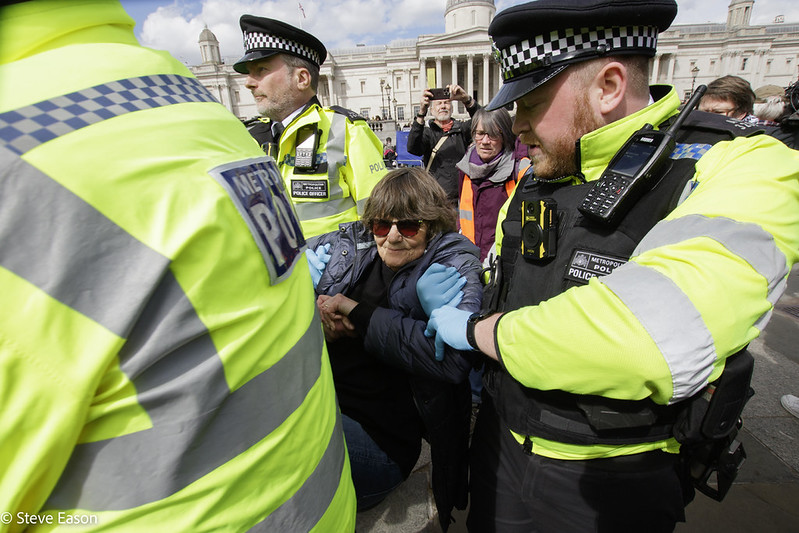
The reality, however, is that both Rishi Sunak’s and Starmer’s governments have attacked the marches and put pressure on the police to move against them. The police have imposed unprecedented restrictions on marches, mobilised huge numbers of officers to enforce the measures, publicly denounced the demonstrations and snatched protesters for the wrong placard, t-shirt, slogan or pamphlet, assuming the role of thought police.
In January 2025, the movement was blocked from marching to the BBC – a march the two of us helped organise. The ban on marching anywhere near the headquarters of our national broadcaster was a new departure. Even more chilling, we were told to either march where police wanted us to, or we couldn’t march at all – a worrying precedent.
A ‘static assembly’ in London’s Whitehall was organised and thousands gathered. A small delegation, including the two of us, decided to proceed to the BBC or, if stopped, to lay flowers at the feet of the police to symbolise Israel’s killing of tens of thousands of children in Gaza. There is a huge amount of video showing the police ushering our small delegation through their lines, and yet one of us was violently arrested and the other called in for a police interview the following day. Charges were brought against us and two other leaders of the movement, Sophie Bolt and Alex Kenny, for breaching restrictions, and in April this year the two of us were convicted of breaching Public Order Act conditions.
The crackdown on marches has been enabled by a raft of new legislation designed to toughen up already draconian protest laws, including this year’s Crime and Policing Act, which makes it easier to ban protests on the grounds of cumulative impact. This will give the police powers to ban, for example, a protest in the whole of London, for an unspecified period, on the grounds other protests have taken place somewhere in the city even if on a different issue.
A separate clause will give police powers to ban protests in the vicinity of places of worship. The claim used to justify this measure is that national marches for Palestine target synagogues. This is a deliberate fabrication. No march has directly passed a synagogue, and there is not a single documented incident of those participating in the marches directly threatening or harassing anyone seeking to worship in a synagogue.
The conflation of support for Palestinian rights with antisemitism and support for terrorism has been used to back suppression of activism in support of Palestine across society. The Civil Service Muslim Network was suspended, doctors and nurses have been disciplined and suspended by the General Medical Council for showing public support for the Palestinian cause, and students and staff have faced disciplinary action over Palestine in at least 28 universities. We have been told that banking workers have been forbidden to go on Gaza demonstrations. In many workplaces, people complain of being afraid to wear Palestine badges or even to talk about the issue.
This is part of an authoritarian trend going back a few decades and accelerating in the face of the anti-Iraq War protests and post-2008 campaigns against austerity. But it has reached a new intensity over Palestine.
It is designed to maintain a status quo in which supporting Israel and maintaining the special relationship with the US – Trump or no Trump – are sacrosanct across mainstream politics. In this, it is a product of weakness, not strength. These establishment positions are haemorrhaging support. Popular opinion has turned decisively against Israel in all age ranges and social groups. Only 13% support Israel’s actions in Gaza, while a majority support an end to all arms sales, rising to 78% of Labour Party voters.
When you are losing the argument, repression becomes increasingly attractive.
The actions taken by successive governments against the Palestine movement threaten basic rights in this country. In this sense, the movement now stands at the frontline of defending democratic freedoms. As Burnham took office, the Palestine solidarity demonstration on 18 July was an opportunity to try and force real change from Labour, and the demonstration on 10 October will be another. The defence of all of our civil liberties and an end to the repression of those protesting genocide are key demands.
Chris Nineham and Ben Jamal will be appealing their convictions in court in December.
Chris Nineham is the vice chair of the Stop the War Coalition.
Ben Jamal was the director of the Palestine Solidarity Campaign from June 2016 to May 2026.
Source: Zeteo.uk