
World War Three is no longer a subject for movies and fiction alone. The threat is all too real.
The conflict in Ukraine threatens to spread at any moment. The US-Israeli attack on Iran has heightened tensions worldwide. Military posturing against China is escalating.
Already, working people are paying the price in terms of ever-rising arms budgets as Europe builds up its military for war. In Britain, the overseas aid budget has been eviscerated to pay for Keir Starmer’s military ambitions, and the pressure on public services is growing. Incoming Prime Minister Andy Burnham has shown scant signs of breaking with these priorities.
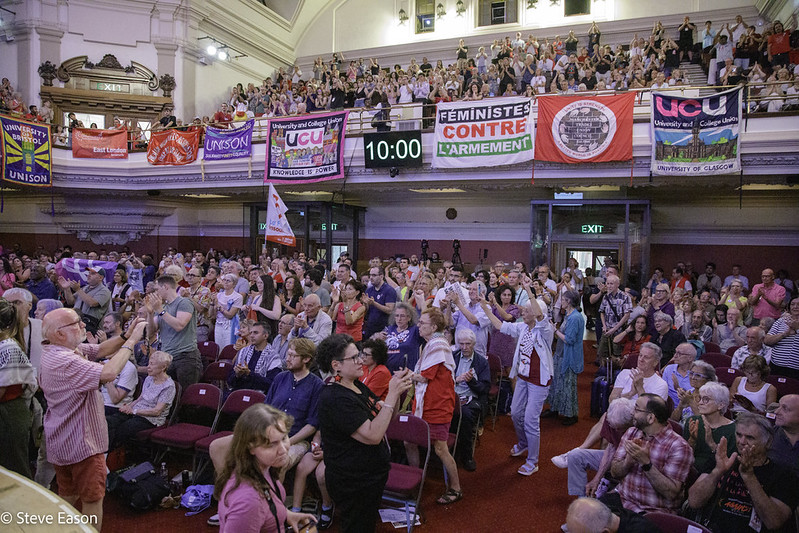
In this setting, the development of an international anti-war movement could hardly be more important. The conference convened in London by the Stop the War Coalition in June was a major step in that direction, following on an initial gathering in Paris last year.
Three thousand delegates attended, including from more than a dozen national trade unions in Britain, and 100 other organisations across the country. They were joined by delegates from across Europe and the USA – around 800 from France alone, with more than a hundred from Spain and about fifty from Germany. There will be a further conference next year, most likely in either Spain or Germany.
Speakers included Mustafa Barghouti from the Palestinian National Initiative and anti-war representatives from Russia and Ukraine. The main conference was preceded by an activists assembly giving delegates the chance to exchange experiences across borders. Throughout there was an atmosphere of boiling militancy and enthusiasm.
The main focuses of the conference were solidarity with the Palestinian people, and opposing the arms build-up across the continent. The statement agreed by the conference was headlined “not to militarisation and conscription” and “welfare not warfare”, which summed up the priorities.
The statement, reproduced here, set out the politics and next steps for the international movement:
“From this International Anti-War Conference we raise our united voices: against war and genocide, and the growing nuclear threat, and for peace. We have come together to raise the alarm: to halt the drive to war, and the nationalism and racism that it breeds. Together we say no to rearmament and conscription, and yes to well-funded health, education and public services, decent jobs, and higher wages.
“We recognise and condemn the complicity of the governments that have facilitated and continue to enable the genocide in Palestine, that have fuelled the horrific bloodbath and obstructed a ceasefire in Ukraine, that have attacked sovereign Iran, Lebanon and Yemen, and continue to engage in war and military intervention across the globe. Millions are dead and wounded as a result, infrastructure destroyed, and lives, opportunities and hopes devastated, to save the capitalist system that breeds war and barbarism.
“We do not accept the descent into chaos and war, much of which can be laid at the door of US imperialism. We absolutely reject Trump’s political and military intervention in Venezuela, his warmongering towards Cuba, and we affirm our solidarity with the peoples of all countries threatened by Trump and his allies.
“We also recognise and condemn the role of European governments, in particular those of Starmer, Macron and Merz, in escalating the drive to war: we reject their active preparation for war, taking place across our continent, the constantly increasing NATO military spending, and we commit to opposing and reversing it.
“We reject the degeneration of our societies caused by the plunder of public wealth from our communities and public services into the pockets of the arms manufacturers. We are not fooled by the false narrative which says that spending on weapons will regenerate our industries and economies. We will support and encourage trade union opposition to military spending.
“We support real investment into our societies, to provide genuine security for working people and our diverse communities: for our health care systems, for decent wages and working conditions, transport, education and housing. We will not accept military conscription and the militarisation of education: we will not allow our sons and daughters to be sent to kill and be killed.
“We face formidable odds and unprecedented challenges. Today we recognise that the only way to be effective against the powerful forces ranged against us is to be internationally organised and to work and act strategically in the interests of the people. Solidarity is crucial, but so too is international coordination, together with the labour movement, to fight back against warmongering governments and increased military spending. We will work together to develop a framework to take that forward.
“Building this movement is essential to secure a future for our planet, for humanity. This is our pledge here today: to organise an unstoppable movement for peace, against the US imperial project, and to fight for the lives and livelihoods of all working people, for another better world.”
The statement also set out forthcoming actions for the movement worldwide. These are a day of action for Palestine on October 10; a weekend of action against militarisation and conscription on November 21 and 22, and a dockworkers day of action against war on a date to be confirmed in October.
The conference represented a major step forward for the Stop the War Coalition. Apart from the inspiring enthusiasm, it reconnected the coalition with major strands of support, particularly in the trade unions.
This must assist in winning the critical argument in the labour movement over the arms race. As well as demanding that the new Burnham government end Labour’s support for Israel and abandon the bipartisan policy of prolonging the Russia-Ukraine war, with all the dangers that carries, it must insist on abandoning the Trump-ordered military build-up.
None of the social and economic ambitions Burnham claims to aspire to will be possible if an ever-growing portion of the economy is devoted to destruction. Instead, he needs to offer a plan for reindustrialisation that does not rely on weaponry.
But the economic price of the preparations for war is only the lesser part of the problem. The ruling classes are marching Europe towards war. The labour movement must act for a different policy as a matter of urgency, and mobilise on an international basis against the warmongers. The London conference was a powerful basis for that critical work.
Source: Labour Outlook