
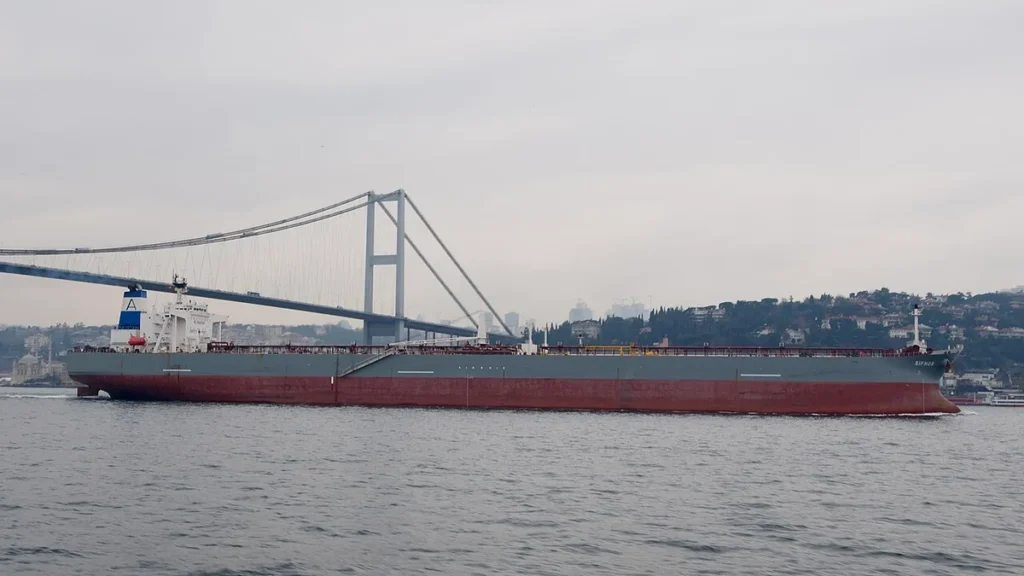
The capture by the Houthis, also known as Ansar Allah (supporters of God), of much of Yemen’s Red Sea coast and areas adjacent to the Bab al-Mandeb strait, plus their three successful attacks on Saudi Arabia’s east-west oil pipeline, reportedly hitting vital pumping stations, has brought a complete halt to all Saudi oil and energy exports, and the closure of the exit and entry point between the Red Sea and the Indian Ocean.
The Houthis have seized the Greater and Lesser Hanish islands in the southern Red Sea, about 160km (100 miles) north of the Bab al-Mandeb strait. Their recent advances also include Mayyun Island, at the mouth of the Red Sea.
This at a time when, despite Donald Trump’s claims to the contrary, the Strait of Hormuz is effectively closed.
This is very bad news for the global economy, which is already highly fragile because of Trump’s lost war with Iran. In June Saudi Arabia was exporting approximately four million barrels of oil per day from the Red Sea port of Yanbu, up 400 percent from pre-Iran war levels. And the Bab el-Mandeb strait emerged as a much-needed alternative to the Strait of Hormuz for global oil flows, with currently more than seven million barrels per day transiting the strait in June, up from roughly four million barrels before the Iran war.
Now its exports are zero.
Saudi Crown Prince Mohammed bin Salman has twice phoned Trump requesting US military help, which Trump refused. Even he must realise that America is in no position to fight another war in the region after getting a bloody nose from Iran.
In 2025 America launched naval and air strikes on Yemen, Codenamed Operation Rough Rider. Trump ended it, agreeing a truce with the Houthis which still holds.
This conflict also has the potential to destabilise Saudi, as I will explain.
Saudi Arabia fought a decade long war, backed by the US and UK, against the Houthis, centred on an air war targeting civilians before the United Nations brokered a ceasefire in 2022. That broke down in July with the Houthis targeting Saudi shipping in the Red Sea.
The Saudis have resumed airstrikes but these did not defeat the Houthis before.
The Houthis use small boats, drones, and missiles to attack commercial ships. Despite US, Israeli and now Saudi airstrikes they can continue to produce these domestically or procured through their diverse supply chains.
Edmund Fitton-Brown, a former UK ambassador to Yemen, told The Independentthat after months of attacks at sea, the Houthis ‘think the moment has come to call the Saudi bluff’.
He adds:
‘They think the Saudis have lost the stomach for the fight. They think that they showed themselves to be weak and frightened in the face of the Iranians. And the Houthis think that this is the moment where they can effectively raise their demands and get the Saudis to concede even more advantageous terms than they were previously willing to do.’
Saudi economic growth and fiscal stability remain tightly tied to hydrocarbons, making up 70 percent of its export, with rising debt, high spending, and lagging foreign investment adding pressure.
A recent analysis of where matters stand in Saudi pointed out, “Defense spending, already at 7.3 percent of GDP and among the highest globally, is rising further through emergency procurement and operational deployment costs. The Saudi-Emirati rivalry in Yemen is adding further expenditure. The stability premium that underpinned Saudi Arabia’s proposition to foreign investors, a reforming Gulf state pursuing a generational economic transformation, a safe haven in a region shaken by conflict, has taken a serious blow.
While Saudi Arabia has suffered relatively less damage than the UAE, Kuwait, or Bahrain, the strikes on the Ras Tanura oil refinery and an East-West pipeline pumping station showed that Saudi energy infrastructure is not invulnerable. Every future investment decision about Saudi Arabia now carries a regional conflict risk premium that was priced at near-zero before February 2026.”
28 February 2026 was, of course, the date US and Israeli attacks on Iran began.
It should be recalled that the House of Saud took control of what is now Saudi Arabia by armed force, helped by Britain, declaring the new state in 1932. They uphold an extreme, puritanical version of Islam, Wahhabism, which is not popular with many Sunni inhabitants nor with the substantial Shia minority.
Any sign of weakness in Riyadh could ferment unrest internally.
Saudi Arabia is a major investor in the UK and a major trading partner with close links between the two ruling classes, their armed forces and their deep states. That explains why Andy Burnham is considering joining with Saudi in air strikes on Yemen.
Given Britain’s colonial past in Yemen and the fact that it was forced out by an armed rebellion this seems utter madness.
Meanwhile, there seems no sign in any peace deal between the US and Iran. By prolonging a lost war Trump is playing with fire both domestically and internationally, not least over the fate of the global economy.
Source: Counterfire