
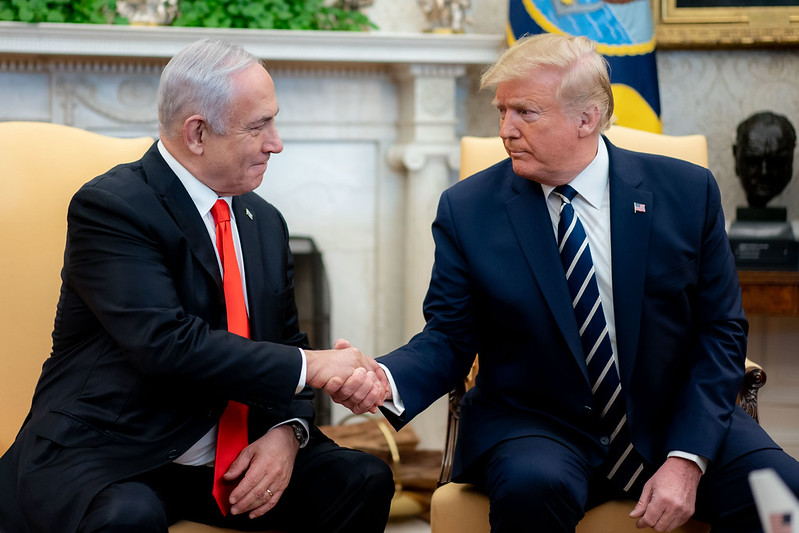
President Trump met Prime Minister Netanyahu in the White House on Wednesday, a few days after a round of indirect talks between the US and Iran, brokered by Oman, came to an end. The Trump-Netanyahu meeting was unexpectedly brought forward and took place in private, creating speculation that Israel and the US might not be on the same page when it comes to Iran.
Trump said afterwards that nothing definite had come out of the meeting and reaffirmed that talks with Iran would be going ahead. Netanyahu’s office tweeted that the PM had emphasised Israel’s security needs to President Trump and the two had agreed to continue coordination. Iran is undoubtedly negotiating from a position of weakness after the 12-day war last June and the instability caused by worsening economic conditions. Trump is keeping up the pressure with constant reminders that the US could attack if talks don’t go well.
Iranians were driven onto the streets by a combination of high inflation and the collapse of the rial – the result of one of the heaviest ever sanctions regimes imposed by the US after 1979. Food inflation exceeded 70% in 2025 and between 30% to 40% of Iranians are now believed to be living below the poverty line. A dramatic downturn in living standards has combined with continuous threats by Trump that further military attacks are likely if Iran fails to accede to US demands.
Despite suggestions by the BBC and others that Iranians took to the streets in January to call for the reinstatement of the royal family, Trump has shown no interest in meeting Reza Pahlavi, saying it would be ‘inappropriate’ to meet with the exiled son of Iran’s former Shah. Netanyahu, however, has held talks with Pahlavi.
Netanyahu called on Iranians to overthrow the regime during the military attack by Israel and the US last June and reiterated his call for regime change when Iranians took to the streets. Danny Citrinowicz, a long-time Israeli intelligence officer, now a researcher with Israel’s Institute for National Security Studies, recently suggested that this was ‘a golden moment’ to attack Iran, with so many US forces in the Gulf.
At the same time as Trump met Netanyahu, Iranians were out on the streets again to celebrate the anniversary of the Iranian revolution which overthrew the Pahlavi dynasty and broke with US influence. In his address, President Masoud Pezeshkian reiterated that Iran was not seeking nuclear weapons, and committed to allowing verification inspections of its nuclear sites. This represents a retreat from the refusal to allow International Atomic Energy Agency (IAEA) inspectors access after June 2025.
This latest move is unlikely to bridge the negotiating gap between the US and Iran. Whilst Iran is insisting talks are confined to its nuclear programme and wants a commitment to lifting sanctions if an agreement is reached, the US is pressing hard for talks to include Iran’s ballistic missile programme and its relationship with Hamas, Hezbollah, the Houthis and other regional supporters.
A series of discussions took place with regional neighbours ahead of the US-Iran talks. Turkey, Qatar, and Egypt, as well as Oman where the talks were held, have all offered support in facilitating US-Iranian talks. Iran’s Foreign Minister Abbas Araghchi held consultations in Istanbul before talks opened; and Qatar’s Prime Minister visited Tehran shortly after which Ali Larijani, head of Iran’s Supreme National Security Council said a structured negotiating framework was beginning to take shape.
These discussions are a sign of intensified concern across the Middle East about regional spill-over should the talks break down. Despite agreement for a further round of talks, Trump is leaving the possibility of future military action on the table. The anti-war movement must remain on alert to the real possibility that miscalculation, misunderstanding or deadlock could precipitate further military action.
Whilst previous US administrations – most notably that of President Obama – have focussed on curtailing Iran’s nuclear programme, the Trump White House has taken a very different stance during both terms in office. Trump is demanding much more than restrictions on Iran’s nuclear programme.
He made this clear during his presidential campaign in 2024 and formalised it in National Security Presidential Memorandum, which was signed within weeks of Trump taking office in January 2025. NSPM 2 – entitled Imposing Maximum Pressure on the Government of the Islamic Republic of Iran, Denying Iran All Paths to a Nuclear Weapon, and Countering Iran’s Malign Influence – seeks three things:
These demands amount to a complete capitulation by Iran – that it gives up its ability to inflict militarily damage on Israel and foregoes its influence in the region. Were any government to acquiesce in such ultimatums, it would mean their end. In the case of Iran, it would help clear the way for Israel to become the regions single ‘superpower’, which is Trump’s goal for the Middle East.
Despite Trump’s unquestionably military superiority not all the cards are in his hands, although there is little doubt in the last analysis the US will be prepared to use military means. The key to grasping the constraints Trump is under lies in understanding his strategic objectives for the US in the Middle East, and the obstacles to achieving them.
Trump wants a stable Middle East dominated by Israel in order to turn US attention to securing what he now describes as the Western Hemisphere – in effect, an expanded redefinition of what used to termed ‘America’s backyard’. Latin America, Canada, Greenland, and the Arctic, together with a relationship with Europe’s Nato allies in which the US maintains a dominant role, is posited as Trump’s economic and military bulwark against the growing presence of China, the United States main economic and political rival.
The US National Security Strategy 2025 (NSS) suggests the historic reason for the US focusing on and intervening in the Middle East – petroleum – will begin to recede in the next period. Instead, the region will become a source and destination of international investment in industries beyond oil and gas – such as nuclear energy, AI, and defence technologies.
The NSS describes Israel’s security as a ‘core interest’ of the US. The recently published US National Defence Strategy 2026 (NSD) describes Israel as a ‘model ally’. Breaking Iran’s influence in the region is crucial to this objective. However, there are three significant and coextensive stumbling blocks:
The groundwork was laid by two actions in Trump’s first term. First, Trump broke with Obama’s nuclear deal with Iran, the Joint Comprehensive Plan of Action (JCPOA) which lifted sanctions in exchange for verified restrictions on its nuclear programme; and second, he successfully negotiated the Abraham Accords which opened a process of normalising diplomatic and security relations between Israel and the Arab states. This latter rested on drawing the Arab states into a relationship with Israel based on concerns about Iran’s nuclear programme and their desire to strengthen ties with the US.
Bilateral agreements that were signed with UAE, Bahrain, Morocco and Sudan (although the latter has never ratified the agreement). They marked the first formal recognition of Israel, since Egypt did so in 1979 and Jordan in 1994. Since then, progress has stalled.
Palestine was a major issue in progressing the Accords. The Accords were criticised by the Palestinian Authority for failing to include a two state solution and unsurprisingly, Israel’s war on Gaza set the normalisation project further back. Saudi Arabia said recognition of Israel would be conditional on establishing a Palestinian state. Meanwhile, the Gulf states have moved towards deepening their own security relations via the Gulf Cooperation Council, and Saudi Arabia is exploring the possibility of developing nuclear capability.
Two events recent events have further impeded progress:
Even assuming it were possible, it would still be unlikely that removing Iran from the equation would be sufficient in itself to deepen relations between Israel and the Arab states. On the contrary, a more likely scenario would be a spill over of conflict into Lebanon, Iraq, Syria and elsewhere. Finding a resolution on Palestine that is acceptable to the Arab states, let alone Palestinians, is even less likely.
Like everyone else, Middle East states are realising Trump’s America is not a reliable ally.
The genocide in Gaza has severely damaged Israel’s international standing, not only among the nations of the Global South but in Europe and North America. Israel is increasingly viewed as a pariah state, with some countries recalling ambassadors and cutting ties. Israel is facing numerous legal challenges and cultural and academic boycotts. Public opinion has plummeted, including among younger generations of Israelis. This is demonstrated by the ability of anti-war and solidarity movements to mobilise support on the streets of London, and across North America and Europe for over two years.
The impact to Israel’s global standing is profound and long-term. In the Arab world, Israel is increasingly viewed as a greater security threat than Iran, and the US as an unreliable ally. The anti-war movement in Britain must recognise these changes. Our job is to demand no support from Britain for war on Iran by the US and Israel.