
Simon Dawson / No 10 Downing Str
The government is hurtling the UK towards war and most of the media don’t seem too bothered by the prospect. In fact, rearmament can’t come soon enough for many commentators and broadcasters.
In his recent speech at the Munich Security Conference, Keir Starmer announced that he was sending a strike group of warships, jets and helicopters to the Arctic to counter ‘Russian threats’, doubling the number of British commandos in the region and building a fleet of warships ‘to hunt Russian submarines’.
In a clear statement that the UK is on a war footing, Starmer also asserted the need to build up the UK’s military muscle: “We must build our hard power, because that is the currency of the age. We must be able to deter aggression. And yes, if necessary, we must be ready to fight.”
He then promised to speed up the planned increase in defence spending from its current 2.3% to 3% of GDP by the next parliament at a cost of between £13bn-£17bn a year. This was initially proposed in order to mollify Donald Trump but the prime minister is impatient for change: “To meet the wider threat, it is clear that we are going to have to spend more faster.”
At a press conference in Downing Street immediately on his return to the UK, Starmer then repeated the urgency of meeting the threat posed by Russia: “We need to be alert to that, because that’s going to affect…every single person in this country, so we need to step up.”
None of these dramatic announcements led to front pages or editorials questioning the use of such hawkish language or the likely disastrous impact of a significant rise in defence spending on public services and welfare budgets. Instead newspapers mostly focused on his lack of clarity on precisely when the increase in defence spending is going to kick in. As the Telegraph put it in an editorial the day after his speech criticising Starmer’s ‘rhetoric in Munich’: ‘show us the money’.
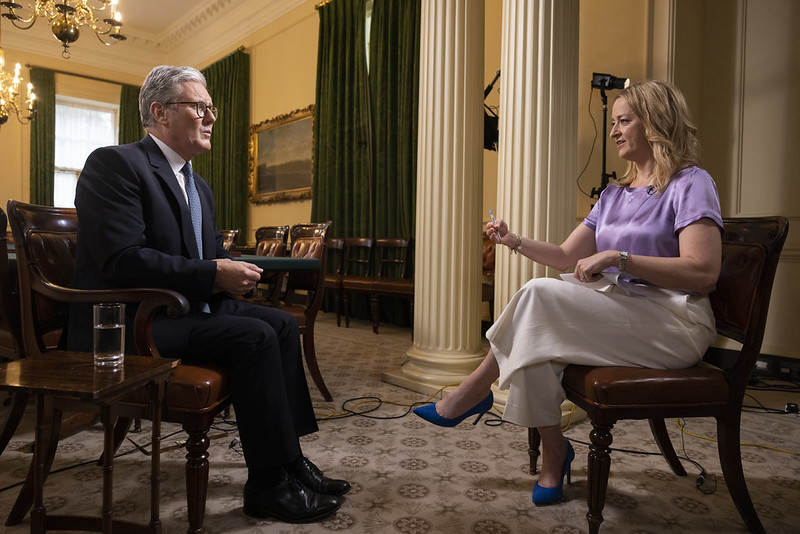
TV bulletins largely followed suit, carrying brief clips of the speech but without providing any significant context or analysis. In her ‘flagship’ Sunday morning show, Laura Kuenssberg did at least focus on Starmer’s statement about being ‘ready to fight’. However, her sole challenge to foreign secretary Yvette Cooper on the issue of defence was to point out the government’s ‘hollow’ promise to increase defence spending without giving any detail of how it plans to pay for it beyond 2028.
The Guardian ran a front page story on defence to coincide with Starmer’s speech in Munich. Yet far from providing a critical perspective, the traditionally ‘liberal ‘ title led instead with an exclusive opinion piece from the defence chiefs of Britain and Germany making what they described as the ‘moral’ case for rearmament. Channeling their inner Ronald Reagan, Air Chief Marshal Sir Richard Knighton and General Carsten Breuer insisted that: “Strength deters aggression. Weakness invites it.” Crucially, they went on to claim that the threat of a Russian attack justifies the “biggest sustained increases in defence spending since the end of the cold war. That’s why it’s important that we communicate the threat.”
Of course, the Guardian is not the only title to be on hand to “communicate the threat”. Whole sections of the UK media – with the exception of The National – are more than happy to perform this kind of stenography.
For example, according to the Nexis database, references to the ‘Russian threat’ or the ‘threat posed by Russia’ have appeared more than 2600 times in articles and bulletins in the last year. Platforms across the BBC are responsible for approximately one-third of all references.
Rather than forensically discussing the nature of any Russian threat and analysing the consequences of such a large hike in defence spending, the mainstream media are amplifying the government’s agenda. What little debate there is on the topic is firmly focused not on whether but how to increase military spending.
This was illustrated by a long feature on defence spending on the BBC’s World at One programme on 16 February. It featured an IFS economist, Bee Boileau, mapping out the different ways of paying for the increase and included an interview with General Sir Richard Barrons, author of the government’s 2025 Strategic Defence Review, where he argued passionately for cuts in welfare to pay for the military. “It is absolutely clear”, he stated without opposition, “that the world we find ourselves in is sufficiently threatening that we are going to have to find more money for defence sooner.”
James Landale, the BBC’s diplomatic correspondent also took part in the discussion and went on to write a long article for the BBC’s website on the prime minister’s proposed increase in defence spending. The article quotes the PM, the chief of the defence staff, Downing Street sources, Treasury officials, the Office for Budget Responsibility, Boileau from the IFS, the foreign secretary, Whitehall sources, defence sources and a spokesperson from the Ministry of Defence.
Critical voices – including left-wing MPs, peace campaigners and anti-austerity activists – are entirely excluded.
Yet the consensus – shared by the media and political classes – that Britain is in imminent danger and that, in response, a programme of rearmament is urgently needed is not shared by the British public who are clearly divided on these issues.
According to a poll for Electoral Calculus in October 2025, 45% believe that there is either a big or fair amount of risk of military attack, while 43% believe the opposite. 32% think it’s likely that Britain will be at war within the next five years and yet nearly the same amount (30%) think the opposite. Compare these figures to the 82% of people who think that global economic problems present a major risk to Britain or the 67% who believe that climate change threatens the UK and it’s obvious that defence concerns are not at the top of the list for most households.
Crucially, Electoral Calculus found that many more people oppose increased defence spending if its means cuts in social security (37% to 29%). It may be obvious to General Sir Richard Barrons that we need to shred the benefits system to pay for rearmament but this is not a view shared by most ordinary people.
Given that the Electoral Calculus poll also found that there is clear majority support for rearmament amongst only Conservative and Reform voters, it appears that the media are disproportionately catering to the most hawkish audiences.
Source: The National