
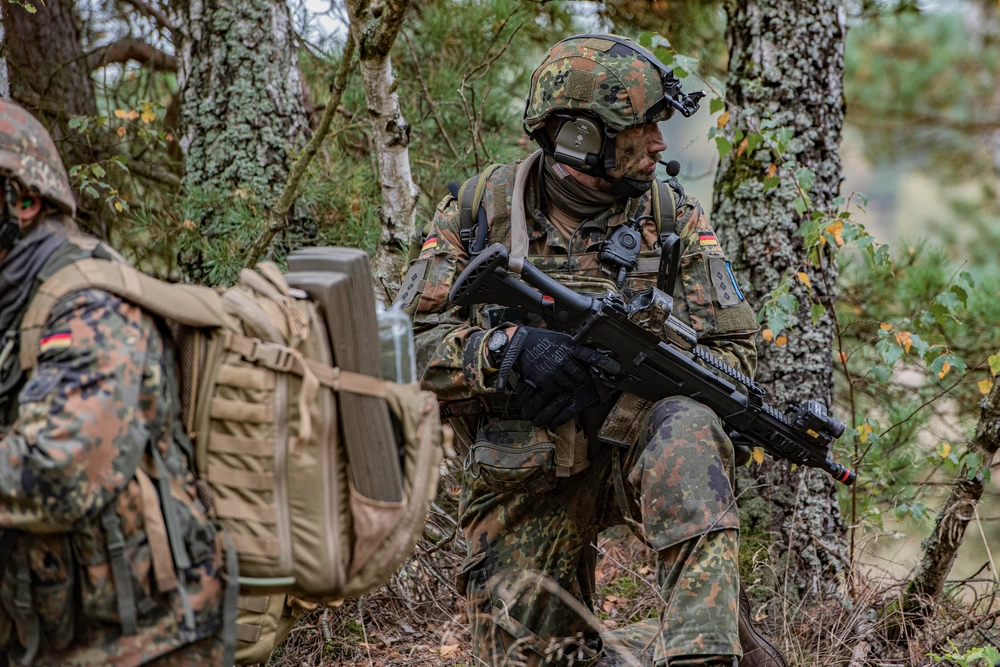
For all the now-ritual invocations of the Second World War, remarkably little attention is being paid to the most obvious historical echo: Germany is rearming, and it is doing so at a staggering pace.
The Zeitenwende – “the turning of the times” – is being built in steel and concrete.
Rheinmetall’s “Project Firepower” has seen factory buildings constructed across 90 hectares of land in the Bavarian Alps. In Lower Saxony, a vast new production facility for artillery shells is being assembled within a 60-square-kilometre site at Unterlüß.
Elsewhere, civilian infrastructure projects have been pushed aside as a new military construction law, establishing an “overriding public interest” for defence projects, makes its way through parliament.
The machinery of mobilisation is being assembled, too. Twenty-four regional examination centres have been established nationwide. From next year, these will be used to carry out medical checks on all 18-year-old men. If the Bundeswehr fails to meet its recruitment targets, the nation’s young and fit may soon face conscription.
British political commentary, meanwhile, is full of praise for Germany’s renewed commitment to “European security”. Chancellor Friedrich Merz’s declaration that “the rule for our defence now has to be ‘whatever it takes’” is paraded as the standard-bearer for all serious European states.
For working-class Germans, “whatever it takes” is proving to be a ruthless proposition.
In July this year, Germany’s ruling coalition agreed a sweeping package of welfare cuts. Some €16.3 billion will be “saved” from healthcare, while the state pension is to be stripped back to little more than “basic cover”. According to Merz, the German welfare state “can no longer be financed” – a claim made as their constitutional limits on borrowing are ripped up to make way for military spending.
The competitive logic of European rearmament is captured neatly in the British press, where one headline recently declared: “The German army used to train with broomsticks. Now, it’s putting Britain to shame.”
Despite Britain’s own military expansion, Germany has now overtaken the UK as Europe’s biggest military spender, increasing spending by 24% in a single year.
Meanwhile, tensions with France are surfacing. Its original €413bn commitment for the 2024-2030 period was rebuked as “insufficient” by the German foreign minister earlier this year. Since then, a further €36bn has been pledged.
Against the backdrop of mass strikes against budget cuts taking place last year, Berlin is urging Paris to take more “difficult decisions”.
But for all the praise lavished on Germany’s new military might, the profound economic and political crisis threatening to engulf German society is easy to overlook.
As money is poured into arms, Germany’s industrial base is haemorrhaging jobs. With the German government throwing its lot in elsewhere, the great pillar of German manufacturing – its car industry – is sliding into crisis.
The wars in Iran and Ukraine have exposed the consequences of years of underinvestment, and in a year the sector has shed 42,300 jobs. Volkswagen’s projected 100,000-job axe is a sign of worse to come.
Against this backdrop of economic stagnation and national mobilisation, the AfD is rising in the polls. One of the most extreme manifestations of Europe’s growing far-right profusion, is expected to make major gains in the eastern state elections this September. Saxony-Anhalt may see the first far-right state government in Germany’s post-war history.
The ruling coalition, meanwhile, is beginning to buckle under the pressure. Merz’s popularity ratings have plummeted and voices within his party, the CDU, are growing louder to reach a deal with the AfD.
One wonders what liberal defenders of European rearmament make of the prospect of that political force inheriting Europe’s largest land army.
For the arms giant Rheinmetall, business has been booming. The company’s valuation has increased more than sixfold since the onset of the war in Ukraine and CEO Armin Papperger expects its order books to swell by more than €100bn by the end of the year.
So far, the Palestine movement has been at the sharp end of Germany’s authoritarian turn. Strict rules on public gatherings, bans on slogans, mass detentions and the instrumentalisation of the asylum system have all been used to suppress opposition.
Then there is the threat of conscription – and the state-wide campaign preceding it. Among the tens of thousands taking to the streets, the joint “moral case” for rearmament made earlier this year by British and German defence chiefs does not seem to be working.
Indeed, so far this year, 6000 young men have applied for exemption from military service on “religious” and “moral” grounds.
For some, opposition to conscription has already become a matter of direct confrontation with the state. Schoolchildren have been arrested amid protests carrying slogans such as “Merz, you go die on the Eastern Front”.
And then there are the thousands of Ukrainian men of military age crossing the German border. In October last year, between 1400 and 1800 Ukrainian men aged 18 to 22 entered Germany each week. Last week, Die Zeit reported that dozens of Ukrainian soldiers had deserted training camps on German soil.
Despite the crackdown, those resisting conscription are now organising across borders. Stop the War Coalition is helping to organise an international day of student strikes and protests against conscription across Europe on 20 November, followed by a global weekend of action against militarism and conscription.
As European rearmament gathers pace, it is those refusing to be sacrificed who express our true common interests.