
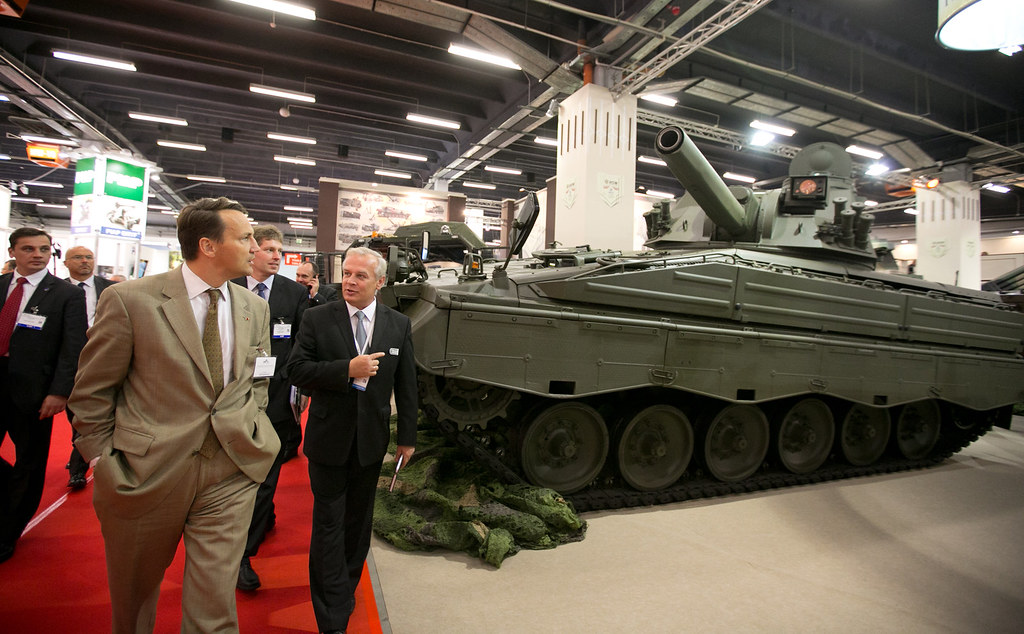
21st International Defence Industry Exhibition MFA
With Donald Trump’ s Ukraine peace plan stalling, there currently remains only one winner in an unwinnable war – the international arms industry. The extent to which this is true is revealed by how the prospects for an end to the Russia-Ukraine war has sent military manufacturing multinationals’ shares tumbling.
“There’s something about a war. You frequently feel lonely when the enemy is gone.” So goes Stephen Sondheim’s track There’s Something About A War, and the recent turmoil on the stock market for one particular German arms manufacturer would appear to bear out the irony in that song.
Because ‘peace anxiety’ really is a thing being experienced by arms company bosses and shareholders as a result of Trump’s efforts to end the conflict in Ukraine, whatever the merits or otherwise of the details.
German political writer Ingar Solty wrote in the newspaper Frietag about this phenomenon, with reference specifically to the company Rheinmetall Defense, shares in which plummeted by over four percent at the prospect of an end to the slaughter in Ukraine.
This was accompanied by one extraordinary media headline: “Fear of peace shocks investors!”
It’s generally been the case that the only way is up for the stock prices of German (and international) arms manufacturers like Rheinmetall since the start of the Ukraine war in 2022. Solty explains that since the then-Chancellor Olaf Scholz’s declaration of a ‘Zeitenwende’ (turning point) on 27 February, just three days after Russia’s invasion of Ukraine, which was seen as an historic shift in German foreign and security policy, Rheinmetall’s share price rose by an eye-watering 2,037 percent – generating a 50 percent increase in revenue to €9.751 billion.
What could possibly burst that bubble? Only the prospect of peace. As one city trading publication’s analysis of Rheinmetall’s stock fall put it: “While some conflicts can increase demand for defense equipment, sudden policy shifts or budget cuts may lead to delayed contracts and uncertain cash flows. This combination of factors creates short-term volatility, prompting investors to sell shares, which further impacts the stock price.”
Solty points to how language becomes particularly enigmatic in times of war – when it comes to killing and maiming people – and the above is an example of just that.
In a nod to George Orwell, Winfried Kretschmann of the German Greens noted that “pacifism now means rearming”. There is nothing more Orwellian than the German government promoting the Bundeswehr as “Germany’s strongest peace movement”, while here in the UK Keir Starmer’s government and his ‘coalition of the willing’ plough billions into keeping a conflict going that has cost at least a half a million lives, while cutting welfare for the poorest at home.
As peace talks failed to make progress, European powers and NATO continued to demand more spending on war. There can be little doubt that the investors in the weapons of war will take comfort from that and will be popping the champagne corks again, in particular celebrating NATO secretary general Mark Rutte’s disclosure that two-thirds of member states have already committed to helping Ukraine with purchases of US weapons through the Prioritised Ukraine Requirements List (PURL) with commitments totalling $4 billion.
We will “make sure Ukraine has the weapons it needs to fight the war,” he said.
Of course it’s the working class, not the establishment and those reaping the financial rewards of militarism, who ‘get’ to fight wars. As Solty says, “The fear of war is not so great among the elite because they are not directly affected. They fear something entirely different: falling share prices for arms manufacturers.”
And then there is Rosa Luxemburg, who said that when “dividends rise, the proletariat falls.” Or, back to Sondheim: “It isn’t just the glory, or the groaning or the gorier details that cause a warrior to smirk, it’s the knowledge that he’ll never be out of work!”