
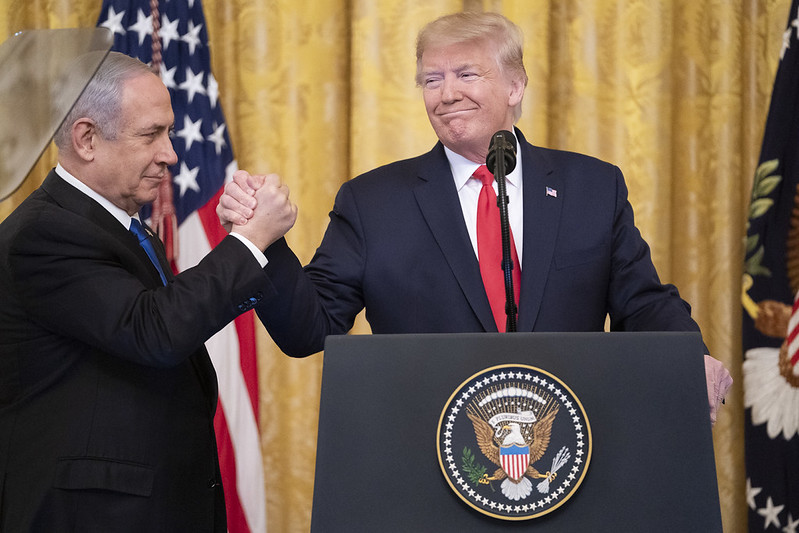
“I think the war is very complete, pretty much,” was Donald Trump’s assessment of the Israeli-American war in Iran earlier this week, after nearly a fortnight of death and destruction.
“[Iran has] no navy, no communications, they’ve got no air force,” the US president continued. “Their missiles are down to a scatter. Their drones are being blown up all over the place, including their manufacturing of drones.”
Iran thinks otherwise: it struck three merchant ships near the Strait of Hormuz days later.
The US military’s recent actions are also in contradiction with Trump’s boasts of success. Having depleted its stocks of missiles and anti-drone weapons, the Pentagon is making plans to move reserves from South Korea, to the evident concern of the government in Seoul. In a further unexpected twist, the US is even turning to Ukraine to supply it with cheap anti-drone defences made locally and costing a tiny fraction of the commercial systems.
For Israel and the US, which began the war with surprise airstrikes on Iran on 28 February, Tehran’s ability to survive is proving far greater than expected. More than 1,000 Iranians have been killed, including the former supreme leader, but the regime is still able to respond to attacks.
As the war intensifies with no end in sight, two key elements are emerging.
The first is that Binyamin Netanyahu, in particular, has fallen into a trap of his own making.
Israel’s prime minister likely imagined Israel and the US would be able to quickly declare victory after assassinating Iran’s supreme leader, bolstering his approval ratings ahead of this year’s Israeli general election.
But with the supreme leader’s son now appointed as his successor, a victory for Israel can only involve completely destroying Iran’s ability to resurrect a nuclear weapon programme. Anything short of this, and its resurrection will be the first aim of any surviving regime – leaving Israel in an even less secure position than before it attacked Tehran.
This total destruction is proving harder than expected, not least because of Iran’s extensive network of tunnels, which I noted in openDemocracy last week. Footage released by Iran’s Islamic Revolutionary Guard Corps last year, which purportedly shows a tunnel full of naval drones, anti-ship missiles, and sea mines, resurfaced this week after the attacks on the merchant ships.
The second issue is more surprising and has emerged only in the past few days.
Having failed to terminate the Iranian regime in the first leadership assassination, Israel and the US are falling back on the Dahiya Doctrine, an Israeli military tactic rooted in wrecking a neighbourhood, a city or even a country to undermine public support for a recalcitrant leadership. In theory, it forces the enemy leadership to give up and thereby lose the war.
The two nations have embarked on an expanded bombing campaign that increasingly targets Iran’s civilian population. As well as the spiralling death toll, thousands of residential properties have been destroyed, displacing more than a million people from their homes.
Civil infrastructure has also been targeted, including banks needed to pay wages. There are numerous reports of hospitals and health centres being hit.
Israel and the US’s use of the Dahiya Doctrine is unsurprising; Israel first used the tactic to attack Hezbollah’s stronghold district of Dahiya in southern Beirut in 2006, and it has since become a valuable tool in its arsenal. Despite Hezbollah’s survival – indeed, 20 years on, Israel is again pummelling Dahiya – Israel used the same approach in four assaults on Hamas in Gaza between 2007 and 2021, and it has been its main policy in the devastating war in Gaza since 2023.
In Iran, expect many more attacks from Israel and the US, killing or maiming many thousands more. Yet a remarkable sting in the tail is emerging that is already changing everything.
Put bluntly, Iran is using Israel’s Dahiya Doctrine against Israel itself.
Iran cannot defeat the combined military power of the US and Israel, but what it can do, and is already doing, is engage in economic warfare on a global scale by targeting the 20% of the world’s oil and gas that originates in the Persian Gulf and passes through the Strait of Hormuz.
Its aim is simple: cause such problems in world energy markets that, in a matter of weeks, there will be huge pressure on Trump and his people to force a pause in the fighting, whatever Netanyahu says.
And the International Energy Agency has already described the situation as one of “dire straits’, warning that “the war in the Middle East is creating the largest supply disruption in the history of the global oil market”.
It continued: “With crude and oil product flows through the Strait of Hormuz plunging from around 20 mb/d before the war to a trickle currently, limited capacity available to bypass the crucial waterway, and storage filling up, Gulf countries have cut total oil production by at least 10 mb/d. In the absence of a rapid resumption of shipping flows, supply losses are set to increase.”
The implication is that a very difficult time of global energy shortages lies ahead.
So while Trump may say the war is “very complete”, it’s far from it.
Source: openDemocracy