
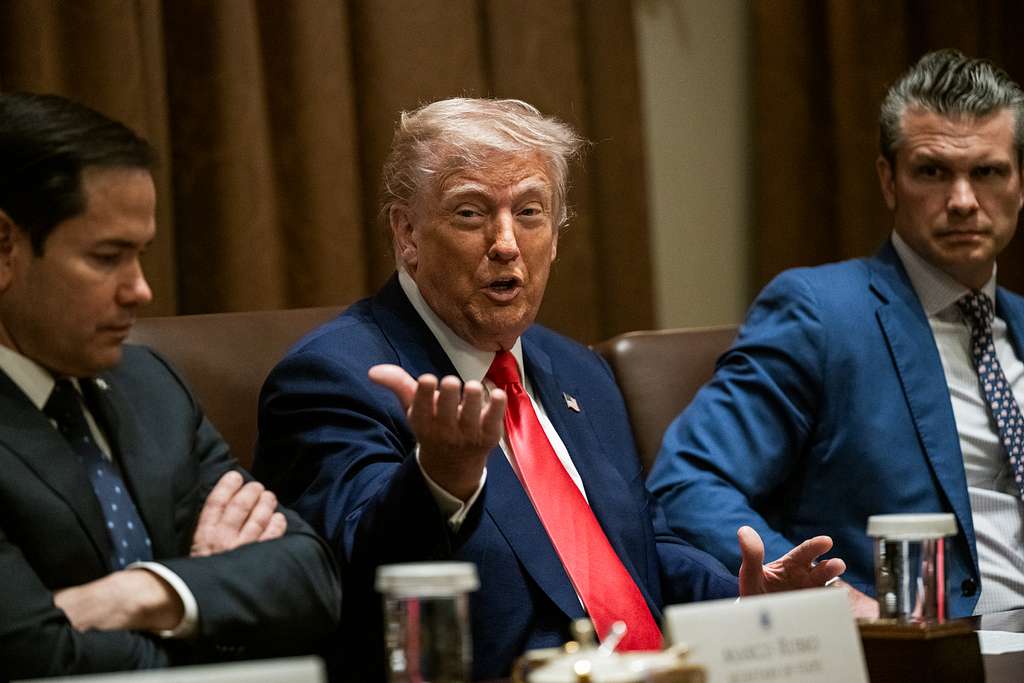
President Donald Trump & Pete Hegseth at a Cabinet meeting, 2025. (Official White House Photo by Molly Roberts)
The phrase ‘bomb them back to the Stone Age’ is generally attributed to US Air Force general Curtis LeMay. He made the threat in the 1960s in reference to the Vietnamese against whom the US was waging a bloody but ultimately unsuccessful war.
LeMay had form as a central figure in the carpet bombing of Japanese cities during the Second World War, which killed in one night alone 100,000 people. The phrase was repeated earlier this year by Donald Trump, then echoed by his defence secretary, Pete Hegseth – this time with reference to Iran.
When Trump launched his war there in alliance with Israeli prime minister Benjamin Netanyahu last February, he promised a rapid victory which would see regime change and the defeat of the major opponent of the US in the Middle East.
It hasn’t worked out that way. Weeks of bombing left infrastructure destroyed and thousands dead, and a retaliation from Iran that clearly Trump and Hegseth didn’t expect.
This was both military – aiming drones and ballistic missiles at US bases and other targets in the Gulf States – and economic, as it closed the Strait of Hormuz to international traffic, thus cutting off supplies of oil, gas and other materials and stranding many ships.
While a common scenario for think tank wargaming is to discuss the impact of the closure of the Strait on Middle East politics and economics, obviously this has never been communicated to Trump.
So the closure and subsequent rise in oil prices seems to have come as a bolt from the blue.
Far from Iran looking weak and leaderless, it demonstrated that despite massive damage inflicted on the country and its military, the vast air and weapons superiority of the US didn’t result in victory for the world’s biggest power.
Trump’s – and Netanyahu’s – failure in Iran led to increasingly erratic behaviour from the US president.
He signed a Memorandum of Understanding with Iran in June as the prelude to 60 days of peace talks, the prospect hailed by him as a great success. This clearly stated Iran would effectively have control of the Strait.
Now Trump has resumed daily bombing, has attempted a US blockade and tariffs on the waterway, and has seen Iran respond with attacks on US bases, with three soldiers being killed in Jordan and Iraq in recent days.
This is unravelling fast for the president and for US interests in the region. He ignored advisers who told him the original attack was not a good idea. He has bombed railway stations, hospitals and other civilian infrastructure in what should qualify as a war crime.
The war is deeply unpopular in the US, including among his traditional supporters. One of his key election promises was “no more forever wars”, given the unpopularity of the Afghanistan and Iraq invasions and occupations. The death of US soldiers in the Middle East brings back the memory of past casualties.
Few seriously believe Trump will come out of this successfully, and he faces a serious test in November’s mid-term elections. But that doesn’t mean he will stop or that he will do anything but make the region more unstable. He is at an impasse.
If he escalates further, including using troops in Iran, he will face a formidable enemy and is likely to be even less successful than previous US wars this century. But if he backs down, then he will have to accept that Iran remains in control of the Strait of Hormuz, and that US power has been defeated.
So the bombing continues, bringing greater loss to the people of Iran, greater instability in the region and the ever-closer prospect of the war spreading.
Already the Houthis in Yemen, allies of Iran, are threatening to blockade the Red Sea, making shipping of resources even more limited and thus leading to greater economic crisis worldwide. The situation in Gaza remains as grim as ever, with more than 1000 Palestinians dead since the supposed ceasefire.
Trump has refused to take the question of the Iran war to Congress, where he fears defeat for his plans. He insulted the European leaders at the recent Nato summit in Ankara, but they in return are too timid to challenge him. The leaders of the autocratic Gulf states are still loyal to the US but clearly unhappy with the impact on their own economies.
The rhetoric about bombing back to the Stone Age has not, mercifully, matched reality. But we should be aware of exactly how dangerous Trump is, and how little regard he has for his own population, for those of Iran and the Middle East.
All of us are likely to pay the price for his reckless warmongering, economically, socially and politically, which is why a mass movement against his pointless war must be built – and fast.
Source: The National