
Under Keir Starmer’s UK Government, the space for dissent is narrowing in ways that should alarm anyone who takes civil liberties seriously.
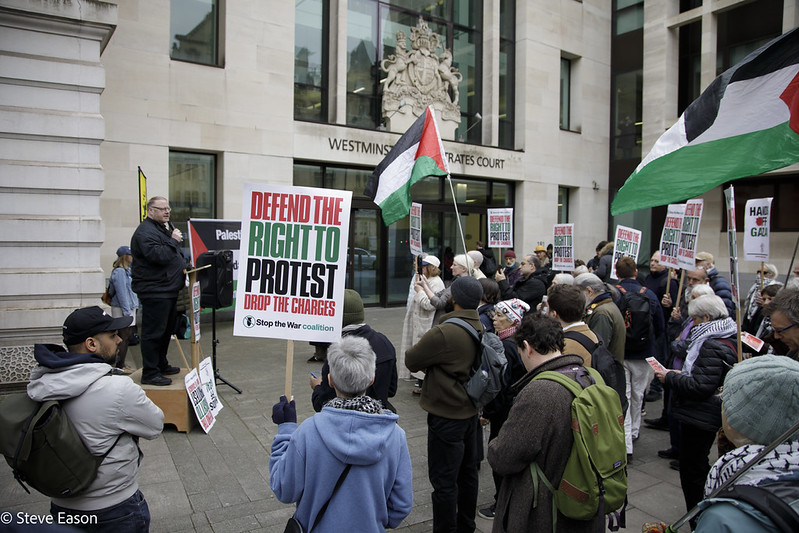
The recent conviction of Ben Jamal, director of the Palestine Solidarity Campaign, and Chris Nineham, the vice-chair of the Stop the War Coalition, for breaching police conditions as organisers of a peaceful Palestine solidarity protest is part of a broader crackdown on the movement.
There is a pattern of targeting protest organisers in an effort to criminalise, discredit and restrict people’s rights to protest against the genocide in Gaza.
The Starmer government’s proscription of Palestine Action marks a dangerous escalation, with the state collapsing the distinction between legitimate civil disobedience and terrorism.
Campaign groups like Defend Our Juries have documented how entirely peaceful acts –holding up signs, speaking out publicly – have been met with mass arrests and prosecutions, mainly in England, with far fewer arrests in Scotland.
The collapse in support of traditional centre parties in Britain and Europe has also created a vacuum in which far-right authoritarian ideas have grown.
This has concrete implications in Scotland. The Scottish Government must be pressed to take a much stronger stand against genocide in Palestine.
It must be pushed to clearly state its opposition to the British Government’s support for the United States and Israel’s latest war against Iran and Lebanon. It can start by publicly condemning the ban on Palestine Action as a dangerous attack on civil liberties.
It must condemn and take action against the use of Scottish airports for US military operations that entangle us in wars across the Middle East, opposed by large sections of the public.
These are two important tests of whether democratic accountability and anti-war sentiment will be fought for or ignored by the current and, most likely, next Scottish government.
There is room for optimism. Our movement has scored important victories, such as the recent High Court ruling that the Government’s ban on Palestine Action was unlawful and disproportionate. It found that the group’s activities did not meet the legal threshold of terrorism.
The court also held that the ban risked undermining fundamental rights, particularly freedom of expression and protest.
Starmer’s government has been further humiliated by its failure to secure a single conviction in the case of the Filton 24, a group of activists who were arrested following a direct action at an arms factory in Filton, near Bristol, operated by Elbit Systems’s UK subsidiary.
All 24 activists were acquitted on the most serious charge of aggravated burglary, and the whole prosecution has been marked by acquittals and dropped charges.
Sustained pressure from below is opening cracks in Starmer’s armoury. Hundreds of thousands have taken to the streets in solidarity with Palestine, demonstrating the enduring capacity for collective action.
Last month, an estimated 500,000 people marched through London against the rise of the far right – the largest anti-racist mobilisation in British history.
These huge mobilisations are giving people the confidence to confront naked power and injustice. Trump’s new wars on Iran and Lebanon are a call for us to say “not in our name” and that we refuse to pay for more wars with vicious cuts to our living standards and public services.
Join us on the national Stop the War Coalition Scotland ‘Break with Trump’ demonstration in Glasgow on Saturday, assembling at Glasgow Green at 11am.