
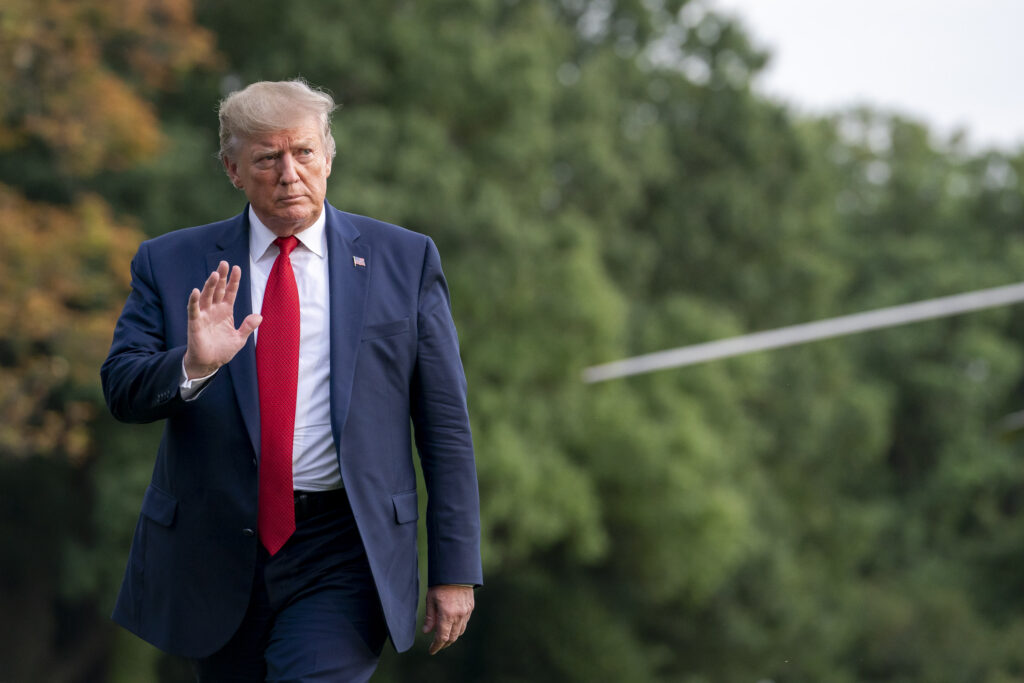
President Trump Returns from Kentucky Official White House Photo by Tia Dufour
If we survive the next decade in a tolerable state of global well-being, we will look back on the second Trump administration with a mix of relief and incredulity; relief that the world survived and incredulity over Donald Trump’s behaviour.
Just how did we come to have a man with his finger on the nuclear button threatening to invade and occupy part of a NATO member state? Not only that, but Trump claims his desire for the US to have “complete and total control of Greenland” – a semi-autonomous Danish territory – was fuelled by the duplicitous behaviour of the Norwegian people in refusing what was rightfully his: the Nobel Peace Prize.
(As Norway’s prime minister has pointed out, the country’s government does not decide who gets the peace prize.)
Trump has been variously described as a narcissist, a solipsist and, less commonly, as pronoid. The latter – believing that people or the world are conspiring to help you, the opposite of paranoia – may be closest to the truth. Trump does appear to irrationally believe that all people see the world as he does.
The dangerous extension to this in his case is that he also sees anyone questioning his infallibility as a profound danger to his world, who must be dealt with accordingly. This leads the most powerful individual in the world to behave like a petulant child throwing his toys out of the pram.
On his pursuit of Greenland, it is worth noting that while European leaders in Davos glibly talk of a “new colonialism”, they are conveniently forgetting their own status as colonial powers and their victories, and eventual defeats, in scores of colonial wars. The US, too, has its own such history, especially the US Marine Corps and its many decades of violent control in Latin America. Not for nothing did Marine Major General Smedley Butler describe his role, after he retired in 1935, as having been a racketeer for capitalism.
As to the present, we have Trump’s worldwide use of economic warfare, with decidedly mixed results. Within the depths of the Heritage Foundation – the organisation behind the Project 2025 blueprint for Trump’s second presidency – and elsewhere in Trump-land, it is no doubt recognised that economic warfare will not ‘Make America Great Again’, given the rapid growth of China’s economic power.
And while Trump’s pronoia may make him unaware of the sharp decline in his domestic popularity – polls suggest his approval rating is at 36%, down from 47% when he took office a year ago – his back-room chums will be all too well aware of it. With the midterm elections due in November, this could spell real trouble for the whole of the MAGA project.
For them, it therefore makes more sense to increase the US’s global standing through military power; a couple of handy little wars to focus the American mind and divert attention.
We are already on the way to achieving that aim. Trump has unveiled a plan to increase military spending by a staggering $1.5trn by next year, and in the last month alone, we have seen repeated US air strikes in Nigeria, Syria and Somalia, as well as multiple attacks and sinkings of small boats in the eastern Pacific and the southern Caribbean. All of this, of course, has been overshadowed by the US’s attempted regime termination in Venezuela, including the kidnapping of the country’s president, Nicolás Maduro.
All of this may seem a far cry from a US president entering into direct confrontation with an ‘ally’, but there is also a precedent for this. Eisenhower used the power of the US dollar to force the UK and France to end their embarrassing Suez adventure in 1956, and Ronald Reagan angered Margaret Thatcher by terminating the left-wing regime in Grenada, a Commonwealth country, back in 1983.
What is striking, though, is the utter openness of the Trump era. His ‘in your face’ approach to geopolitics is fast becoming its trademark and does at least give us some warning of what might come next.
Take Cuba, a state that has been under severe US sanctions for decades but currently has a particular vulnerability: its dependence on Venezuelan oil. Having seized control of Venezuela’s oil exports, Trump has warned Cuba that its supplies will be cut and that it must “make a deal [with the US], BEFORE IT IS TOO LATE”.
Then there is Iran. Over the past week, the White House has insisted that all options are on the table for military action against the country if killings of anti-government protesters continue. This is despite Egypt, Oman, Saudi Arabia and Qatar working to de-escalate the tensions, warning that another US attack, however much to Israeli prime minister Binyamin Netanyahu’s desire, could have dangerous regional consequences.
Given the many weeks it took to get military forces in position to attack Venezuela, any escalation concerning Iran might be many weeks or even months away.
Or perhaps not. The USS Abraham Lincoln carrier strike group has been ordered to make its way to the Middle East from the South China Sea, after the last carrier strike group left the region in December, when its deployment ended. The Pentagon would like to see at least one stationed there at all times, in addition to the 30,000 US troops already based there.
But even that would not really be enough for the current administration, given its preference to have an overwhelming force ready for any foreign operation, so a second carrier strike group appears to be on its way. The USS George H.W. Bush aircraft carrier left its home port on the US Atlantic Coast last week, most likely also headed for the Middle East.
There are two more indicators of a troubled summer ahead. One is that the Pentagon’s house journal, Stars and Stripes, reports that Pituffik Air Base in north-west Greenland is being upgraded in a $25m construction programme. Is the timing of that announcement just a coincidence? Maybe, maybe not.
The other indicator is purely domestic. Troops from the US Army’s 11th Airborne Division “are standing by to deploy to Minnesota should President Donald Trump invoke the Insurrection Act, a rarely used 19th century law that would allow him to employ active duty troops as law enforcement”, according to a report in Military Times this week.
Put bluntly, the US government is putting itself in a position to fight more wars overseas while controlling dissent at home.
In the coming months, much will depend on the extent of domestic opposition and whether that becomes sufficient to curb the dangerous excesses we see emanating from the Trump White House. If not, then the nine months through to the Congressional midterms will likely be a time of added risk.
Source: Open Democracy