
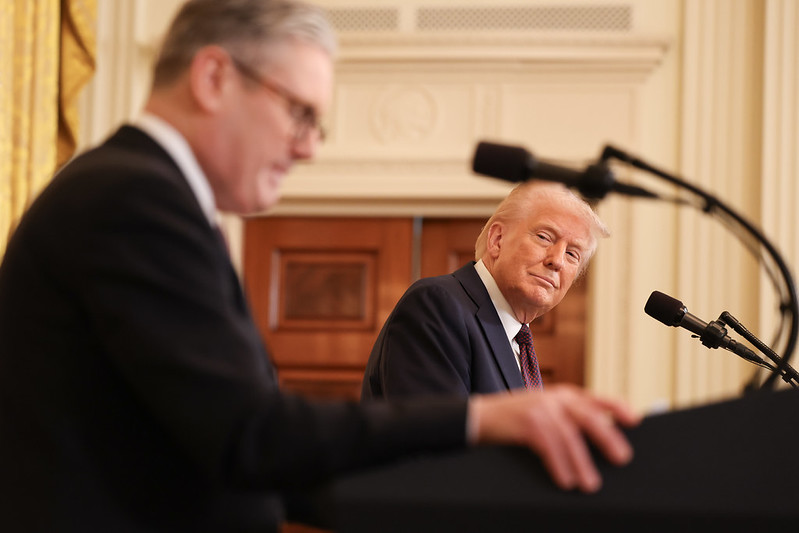
Simon Dawson / No 10 Downing Street
Since the beginning of Donald Trump’s war on Iran late last month, Keir Starmer and his Cabinet have been at pains to insist that Britain is not involved in Washington’s misadventure.
Last weekend, following the UK Government’s decision to allow the US to bomb Iran from RAF Fairford and Diego Garcia, General Richard Barrons broke cover to admit the truth: “Now we are involved.”
Almost as soon as Starmer had greenlit the use of Britain as a launch pad for American aggression, the US president bowed to market pressure and announced the postponement of further air strikes. Britain’s geopolitical impotence revealed for all to see, US supersonic bombers now sit idle on the Gloucestershire tarmac, loaded with 900kg bombs waiting to be dropped on Iran, where 498 schools and 234 health facilities have been struck during Operation Epic Fury.
Even as Trump lifted sanctions on Iranian oil and prepared to wind down the war, Starmer sought to appease his administration.
The Prime Minister laundered British sovereignty without the democratic consent of the electorate, 70% of whom oppose the prospect of military involvement in the region.
Starmer’s decision to abandon his stated aim of ‘de-escalation’ did not follow extensive public discussion or even a House of Commons debate, but rather a rebuke from Washington. After Trump blasted America’s NATO allies as ‘cowards’ for failing to fall into line, the UK Government did just that – and not for the first time.
When the US military was granted initial use of British bases in early March, the American request was, according to The Telegraph, authored by the UK’s chief of the defence staff. One might reasonably expect top brass helping a foreign power to engineer the use of Britain’s military infrastructure to raise eyebrows.
But for Britain’s political class, this subversion of democratic accountability is simply an example of the ‘special relationship’ working as intended.
Already, workers across Britain are bearing the burden of destabilising decisions in which they have played no part and been afforded no say. Fuel prices have soared as cities central to the operation of the globalised capitalist economy have been targeted in conflict for the first time since the Second World War.
For UK households, the consequences are already baked in. In July, energy bills could rise by at least £332 to a three-year high of £1973. Filling up the car at the petrol pump is already £7 more expensive than it was last month.
The price of gas, which set UK energy prices 80% of the time in 2024, peaked at 183 pence per therm last Thursday, having risen from 80p per therm prior to initial American-Israeli strikes.
This is the cost of conflict in a region which supplies a quarter of the world’s energy supply. Warflation – and it is not confined to fuel. Food prices, which have already soared by 38.6% since 2020, will rise once again – not least because one-third of global fertiliser exports originate in the Gulf.
For a country such as the UK, which imports approximately half of its food, such shortages could come with devastating implications.
Then there are the longer-term impacts. Operation Epic Fury drained the global carbon budget faster than 84 countries combined, emitting five million tonnes of carbon dioxide in just 14 days as oil rained over Tehran.
After US-Israeli strikes on the capital’s energy infrastructure, burning fuel fell back to earth in black sheets. Plumes of smoke drifted across the skyline above the city.
Welcome as it is, neither at home nor abroad will a temporary postponement of Trump’s campaign to “obliterate” Iran mitigate these disastrous consequences.
It is too little too late for the 1400 Iranians who have been killed by US-Israeli bombings, just as it is for those who will now absorb the global economic fallout.
Rather, what the events of the last three weeks highlight is the importance of developing a foreign policy agenda which is both independent of the White House and accountable to the British public. Achieving this objective merits far more than a change of orientation in Downing Street. Britain’s nuclear weapons programme, as Starmer conceded earlier this year, “requires us to have a good relationship with the United States”.
In this sense, the ‘special relationship’ is more than a rhetorical fig leaf. It is the organising principle of Britain’s national security and, as Operation Epic Fury illustrates, leaves us dependent on the whims of an ever-more unstable American hegemon.
The war in Iran has wrought havoc across West Asia and will further erode working-class living standards in Scotland.
To oppose those who would allow the UK to become either an accomplice or participant in further regional conflict is not simply a moral obligation; it is a means by which to shield people across these islands from further immiseration amid the soaring cost of everyday essentials.
Source: The National