
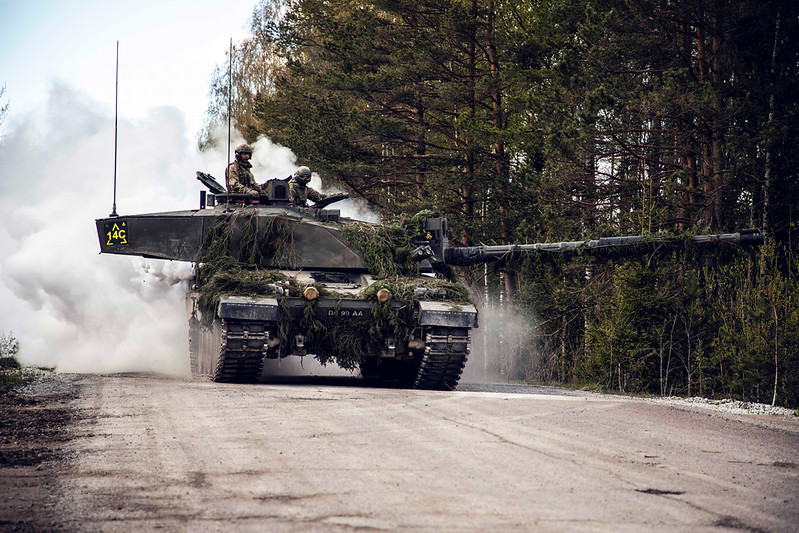
Nato exercise Spring Storm, NATOChannel
More that 10,000 European soldiers are right now engaged in a military war game that simulates conflict in Europe. Significantly operation Steadfast Dart 26 games a European war with the US taking part.
Steadfast Dart 2026 brings together military personnel from 11 member countries, encompassing not only traditional land, sea and air forces but also training for conflict in space and cyberspace. Following accusations that Trump was weakening the Alliance, the exercise was closely watched by European leaders to see how successful it could be without the US Army, the allies’ most important partner.
The ARF is a relatively new concept, having only been set up on 1 July 2024. Its role is to provide multi-domain forces from across the alliance at shorter notice than had been previously possible.
It’s a direct military expression of the Europe wide rearmament programme and seeks to replace Trump’s military machine with one of Europe’s own construction. French President Macron declared that, “Europe must redesign its security architecture independently.”
It’s a direct response to US Secretary of State Marco Rubio’s recent speech at the Munich Security Conference where he declared that the US is determined to build a new world order: “While we are prepared, if necessary, to do this alone, it is our preference and it is our hope to do this together with you, our friends here in Europe.”
Trump’s National Security Strategy (NSS), framed as a modern Monroe Doctrine, shifts US focus from the Western Hemisphere to Europe-Russia relations, economic ties with China, and countering China in Taiwan and the Pacific. By limiting NATO’s conventional support while keeping its nuclear role, the US aims to reduce funding for European defences. Washington’s Ukraine policies, including the Alaska summit with Putin, are seen by European leaders as a benefit to Moscow, reinforcing NATO’s weaknesses and encouraging Russia’s firm stance on peace and internal consolidation.
Add to that the Russian incursion of the airspace of the Baltic states, Germany, Poland and Romania by drones, as well as the entry of MiG-31 fighter jets into Estonian airspace, which has led to near hysteria among the Baltic states, Central European allies, and Germany. All this has driven the rearmament mania across Europe, a mania fully shared by Kier Starmer’s Labour government.
Starmer has gone beyond the demands of US President Donald Trump in accelerating arms spending.
He has said he will increase to three percent of national economic output by 2029, meeting an existing target earlier than planned. Asked about a media report on the open chequebook for rearmament Starmer said ‘So we need to step up. That means on defence spending, we need to go faster. We’ve obviously made commitments already in relation to that, but it goes beyond just how much you spend. It’s also whether you coordinate and collaborate with other like-minded countries, particularly in Europe.. how we make NATO stronger, a European NATO, if you like.’
Britain committed in February 2025 that it would lift annual defence spending to 2.5% of GDP by 2027 and aim for 3% in the next parliament, which is expected to begin after an election due in 2029. Starmer’s statement has underlined that the hike in arms spending is coming.
At the Munich Security Conference on Saturday, Starmer urged Europe to “be ready to fight”. He emphasised that “we are not the Britain of the Brexit years anymore,” adding that “there is no British security without Europe, and no European security without Britain.”
In response the labour movement across Europe is preparing an International Peace Conference in London next June. It will take up the British TUC’s campaign for ‘wages not warfare’ and the Italian activists slogan ‘lower your weapons, raise our wages’.