
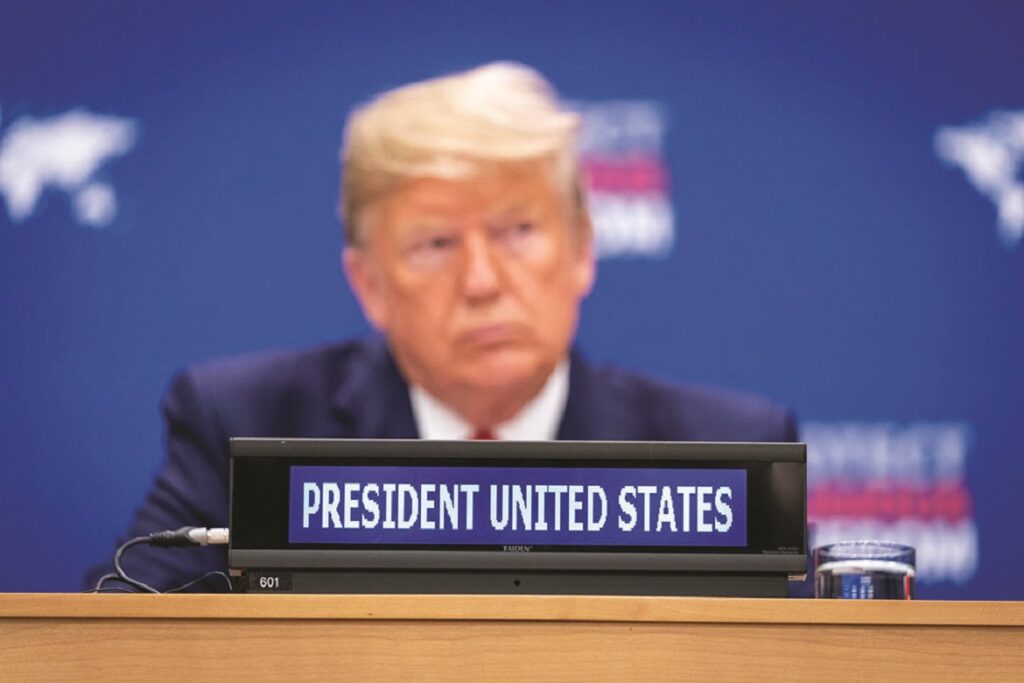
Creator: rawpixel.com / National Archives
‘This is a president of action,’ Marco Rubio.
The bombing of Venezuela and the kidnapping of the president and his wife are the most reckless acts of international criminality so far from Donald Trump. Flushed by his own success, Trump now claims that he will be running Venezuela, extracting its oil for the US, and threatens the presidents of Mexico and Colombia with similar fates – and no doubt anyone else who dares to challenge him.
Trump’s action follows his recent national security strategy document with its insistence of US supremacy in the Western hemisphere and his restatement of the 19th century Monroe Doctrine that the country would regard Latin America as its own sphere of influence or ‘backyard’. This is aimed at its rivals economically and militarily, notably China, from their own attempts to secure hegemony in the region, and also at asserting US power. History provides the evidence, as one commentary notes:
‘Since the mid-19th century, the US has intervened in its continental neighbours not only through economic pressure but also militarily, with a long list of invasions, occupations and, in the case most closely resembling the current situation, the capture of Panama’s dictator Manuel Noriega in 1989.’
Despite much trumpeting about democracy, the US has supported military dictatorships, paramilitaries and murder gangs throughout the region in pursuit of its aims. The 1973 coup in Chile will never be forgotten by my generation, as we watched a US-backed dictatorship murder, torture and force into exile tens of thousands of people. The events in Venezuela should also be seen as a coup – the forcible removal of a head of a sovereign state and his transportation to prison in New York. Unlike most previous interventions, this was carried out quite brazenly and directly by US forces on Venezuelan land, and Trump has made clear that for him this is only the beginning.
These actions amount to war crimes and should be roundly condemned. You can see the actions of an arrogant imperialism not just in the assault itself but in the ritual humiliation of Maduro: the photos of him cuffed and blindfolded; the transport on USS Iwo Jima (named after one of the most important battles between the US and Japan during the Second World War); the claim that he and his wife are simply drug dealers and criminals; the grotesque viewing of the operation by Trump and his ministers in real time (a common practice from US presidents nowadays but one that reminds me of Roman emperors watching the gladiators).
The coup was not about drugs, but about control of a country opposed to the US and of its assets including oil and mineral wealth. This should not be in doubt. That in itself is a gross act of imperialism, but we should not see it as just about Venezuela. The US’s eyes are now on Cuba, which lacks the resources of Venezuela but shares the political opposition to its hostile neighbour, and there is a threat to the stability of the whole Caribbean, especially with a huge US naval presence in Trinidad. However it is also a statement of Trump’s brand of imperialism. It is one that reflects a decline of US hegemony worldwide and a determination to strengthen its power in the region. We have seen threats already to Greenland, to Canada and to Panama, as well as to Latin American states. These will continue and maybe escalate.
These threats will be met not by direct intervention against the US, but with the strengthening of other powers in their own regions. China and Russia, for example, will be looking to strengthening their own hegemony in their regions. They may also feel that Trump’s actions give them a certain legitimacy for similar actions in their own ‘backyards’ – this is after all an argument put by Putin in relation to Ukraine.
The world situation has grown increasingly unstable in recent years with Ukraine, Gaza, Congo, Sudan involved in direct wars and countries such as Iran, Russia and Venezuela heavily sanctioned. The UN order, established after the Second World War, is in tatters. That began with the series of wars led by the US since the end of the Cold War. The Afghanistan and Iraq wars were military and political defeats for the US and Britain, the interventions in Libya and Syria led to much greater instability in the Middle East, and support for Israel’s Gaza genocide has further increased that. Trump’s latest action has added to that instability. The Financial Times commentator Edward Luce put it like this:
‘Whatever way that pans out, Trump’s new world order is now very much a reality. It consists of no obvious rules, does not respect allies, celebrates the jungle and is almost always about money. There is a lot of wealth under Venezuela’s soil. Trump is now committed to extracting it.’
That expresses the alarm from sections of the British ruling class, even if it suggests a greater randomness than is indeed the case. That alarm no doubt extends to the British government, which clearly had little knowledge or involvement in the Venezuela attack. The response of Keir Starmer and his government has been excruciating: a refusal to condemn the regime change and breaches of international law, and the diametrically contradictory positions that the government wanted Maduro to go but respects international law. This leaves out whether the action was itself in breach of international law or justifiable in any way. Starmer’s obsequiousness is matched by the EU leaders, who fear Trump but rush to appease him every time. This is despite the national security strategy explicitly encouraging far-right parties in Europe.
Despite grandstanding from Trump, Rubio and Hegseth, we’re seeing a deepening of their problems with rivals internationally. The Ukraine war is dragging on, Iran is next in Trump’s sights – although it will be a very different challenge than Venezuela. The world is preparing for war.
It is always tempting in such circumstances to believe that the imperialists hold the cards, but the opposition to war has always come from below. This was true over Iraq and it is true today over Palestine. We have an anti-war movement in Britain which has repeatedly provided a strong opposition. Today we must strengthen the Stop the War Coalition and make sure it has roots in every town and city. The imperialist system is at its most dangerous for decades. It is fuelled by a far-right politics of which Trump is the embodiment and by economic and military competition on a historically high scale.
Our focus is on how we break our government’s foreign policy with its supine support for whatever US imperialism does. It is deliberately holding down incomes in real terms and public services in order to fund the military and arms production for war. It is introducing ‘gap year’ military training as a prelude to conscription. A report recently argued:
‘The UK government will need to mobilise more than £800bn of new funding for defence projects and wider strategic infrastructure by 2040 if it is to meet ambitious NATO-related targets set after pressure from Donald Trump, analysis shows.’
This is an eye watering amount of extra money which will have drastic consequences for our health, education and welfare. Opposition to war and austerity go hand in hand.