
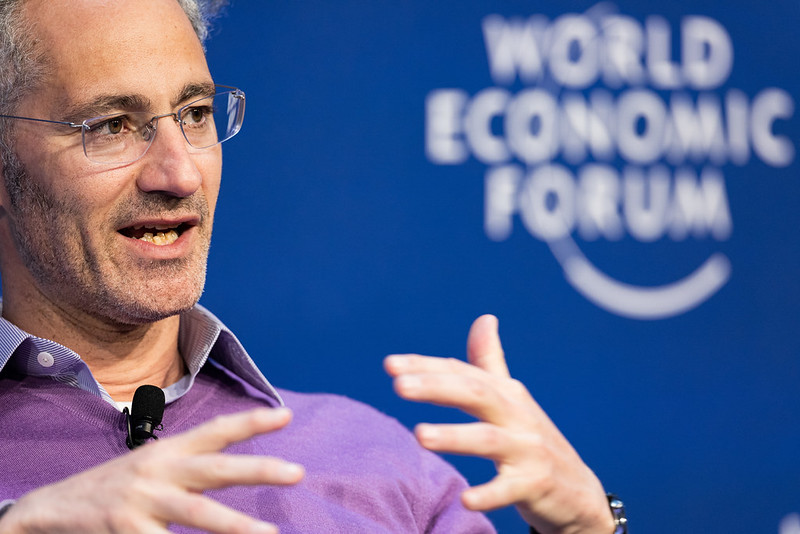
Alex Karp, CEO Palantir – Copyright: World Economic Forum / Benedikt von Loebell
I was told by my mother to “listen carefully to your opponent – you can learn from your opponent”. As a child I was immensely proud of the British Empire – proud of things I had never done – and I hated people I had never met. Only after listening to wiser voices did I lose such antisocial ideas.
Which brings me to Palantir. I listened to Alex Karp, co-founder and CEO of Palantir Technologies, speaking at the World Economic Forum in Davos last week on how Artificial Intelligence (AI) is reshaping warfare, national security, and the real economy.
From Ukraine to hospitals and boardrooms, Karp argues “AI will expose what societies can truly “bear” — and who falls behind”.
Karp is an incredibly articulate man. He gives very well thought out examples of mismatches between an organisation’s belief in how it performs compared to its actual performance on the battlefield. Artificial Intelligence is an incredibly powerful tool. I stopped playing chess when I understood that suitably trained AI will always win.
But his analysis of war in the context of competing enterprises is chilling. An example:
Many “modern” enterprises are partially fictional under stress – systems that exist on slides fail in real operations; Ukraine benefited from starting closer to zero rather than “discovering” gaps mid-conflict.
Karp cites the evolution of tactics between armies from Ukraine and Russia as the war has progressed. There is no acknowledgement of the human cost on each side. He is proud that Palantir is helping Ukraine “equip interceptor drones with AI capabilities”. Ukraine in return has given Palantir a new level of access to critical warfighting data.
If the problem is ‘how do I make our side win?’, whatever the solution, sooner or later the opponent (or its replacement) will also adopt it. So a better question in the context of the Russia-Ukraine war is how did it happen? Because, if we want to avoid future wars, humanity needs to understand what causes them. And that requires answers to searching questions.
Was it a mistake to tell Ukraine in 2008 that it would eventually join NATO? At some time in the future, would Ukraine in NATO be a threat to Russia? Was it also a mistake to help remove a democratically elected, pro-Russian president, Yankovic? (Don’t get me wrong, he was a vile man).
Should discussions over the Minsk agreement have been allowed to be used as a camouflage to arm Ukraine, as former German chancellor Angela Merkel claimed they were?
And was it right to urge Ukraine not to sign Russia’s peace offering in 2022, as was said by the Israeli prime minister Naftali Bennet, who led the country for the first several months of the Russia-Ukraine war.
He has said the United States and its closest Western allies “blocked” his attempts to broker a peace agreement between the two nations.
Above all, why provide enough weapons to keep Ukrainians fighting but not enough to win? Maybe, because sustaining wars in this way the arms manufacturers and spy-tech companies win big. And, after four years of war, Ukraine is losing as its infrastructure is being destroyed.
I don’t believe that Palantir has anything constructive to say on that. Why would it when keeping an unwinnable war going is clearly working to its advantage?
And then there’s Palestine and Israel. Israel was set up as a colonialist state. For extreme Zionists the ethnic cleansing of Palestinians and the establishment of its borders are unfinished business. Palestinians, like every oppressed people in history, object to being killed and evicted. If the problem is how do we kill more Palestinians, Palantir has been and continues to be a willing helper.
But if the problem is how de we get a people conditioned to believe that they have the right to rule over another people to instead co-exist, as equals, with the oppressed, Palantir has nothing to say. It was set up by the CIA and is active in both Israel and Ukraine. Peacefully negotiated outcomes are not in its interests nor in its expertise.
Karp argues that there has been a norm of military innovations spreading to civil society. He believes that AI will spread to the rest of society. And so we see Palantir attempting to spread in our NHS.
In 2023 the government handed a £330 million NHS data contract to Palantir. The Good Law project has the detail. Now this software is rolling out across England. The health service is underfunded; it has to have at its core respect and trust. But Palantir emerges from an industry based on exploiting divisions and hatred. It has no morality. It has to be kept out of our health service.
Please email your local health trust and health secretary Wes Streeting to say no to Palantir.