
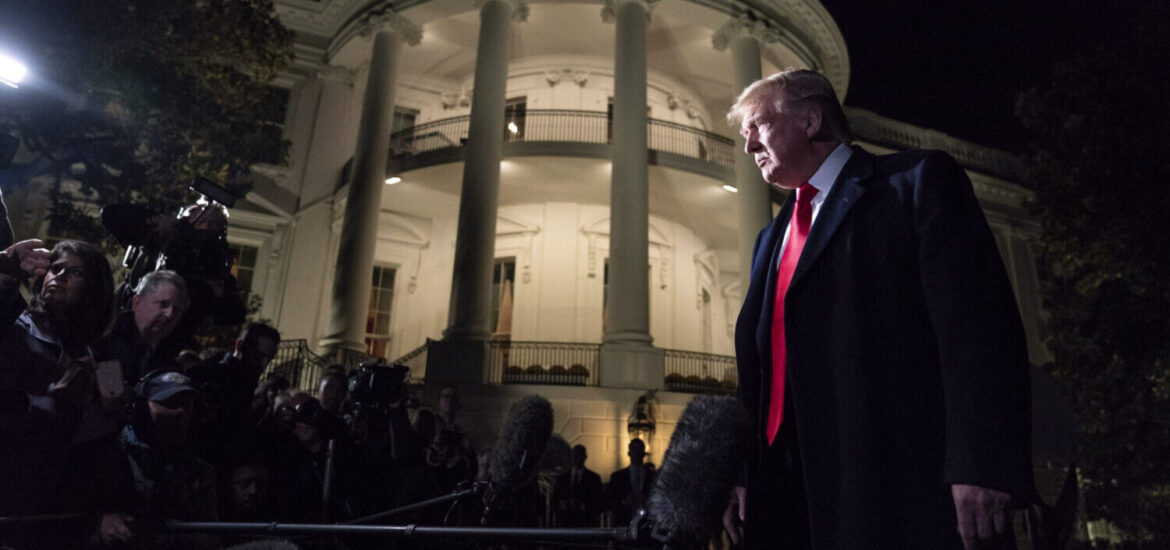
President Trump. Credit: rawpixel.com / National Archives
One week in, there is little prospect of an early end to the Israeli war with Iran and even less of preventing a regional escalation. Given Binyamin Netanyahu’s success in bringing Donald Trump’s United States on board as Israel’s partner in a widening war, he may feel satisfied with progress so far. In reality, though, the conflict is not going according to plan for any of the three states involved.
Netanyahu’s intended outcome was straightforward regime termination in Tehran, with the assassination of the supreme leader and most of Iran’s senior war leaders. A public uprising would then have followed, ending the power of the theocrats.
Israel and the US could then have brought sufficient force to terminate Iran’s nuclear and ballistic missile program and cut back its conventional forces, starting with the abolition of the Iranian Revolutionary Guard Corps (IRGC).
Finally, the removal of the US’s punishing economic sanctions on Iran would have been agreed, allowing some civil recovery for the country – although this would, of course, have been contingent on the new leaders agreeing to oil and gas deals that would prove punitive for Iran and lucrative for the US, likely ensuring Trump’s continued support for Israel.
The Israeli war aims may have been clear, but it is impossible to say for sure what the White House wanted.
A muddle of reasons and statements of intent for bombing Iran have been given by Trump, his secretary of state, Marco Rubio and self-styled secretary of war, Pete Hegseth, who last year sought to rebrand from the ‘secretary of defense’ title that has been used by successive post-holders since the end of the Second World War. While Washington initially embraced Israel’s desire for total regime termination through an uprising, that aim has disappeared from its recent statements. Now it seems that crushing Iran’s military capabilities, starting with its nuclear ambitions, is the US order of the day.
For Iran’s theocratic leadership, the primary war aim was survival in the face of the massive power of the Israeli/US war machine, which would itself have been quite an achievement. Indeed, Iran’s supreme leader, Ayatollah Khamenei, barely survived the first hour or so of the war before being killed in a missile strike.
The unexpected has since become clear: Khamenei is gone, but Iran’s leadership system is likely to survive for now. His successor will probably be his son, Ayatollah Mojtaba Khamenei, who will quite possibly be as hard-line as his father. Israeli defence minister Israel Katz has declared that whoever is chosen as Iran’s next supreme leader will be “a target for elimination” – a clear indication that for Netanyahu and the Israeli Defence Forces, there is no turning back.
If regime survival is one of the surprises of the conflict, the other is Iran’s continuing ability to fire barrages of armed drones and ballistic missiles, which has been the least expected element of the war so far.
By last July, the IDF and the US believed they had massively damaged Iran’s air defences, with Trump boasting of “spectacular military success” in a press conference. On top of this, the past week has seen the determined and intensive targeting of Iran’s missile systems by the combined power of the IDF and US armed forces. Yet to the genuine surprise of many Western political and military analysts, Iran can still launch its missiles.
Three elements of this survival offer a clue as to what comes next.
One is that the regime in Tehran is likely to continue to survive. Look to Gaza, where Hamas is still active despite the massive destruction that Israel has inflicted over the past two and a half years. This, as I noted in last week’s column, is largely down to its quite extraordinary network of tunnels dug mostly by hand and reinforced with concrete walls. The network, which extends to around the distance from London to Edinburgh, has around 5,700 shafts, as well as electricity, ventilation and communication facilities.
In Iran, the IRGC now looks to have been similarly active in extensively preparing for war. It has built numerous and widely dispersed underground ‘missile cities’ – deep tunnel complexes built into mountains for making and storing armed drones and other weapons – as well as producing undersea armed drones for use against the US Navy, especially if it tries to guide tankers through the Strait of Hormuz.
The second element follows on. There are indications that the IRGC appears to be using its older and least advanced missiles and drones first, aiming to deplete Israeli and US stocks of their anti-missile defences. Quite apart from anything else, this means Israel and the US are depleting their high-cost weaponry to “catch” incoming missiles, while Iran saves its most recently developed drones and ballistic missiles – with greater reach and more power for destruction, as well as improved accuracy and reliability – for later in the war.
Finally, there is the decision to opt for economic warfare against Western interests in many Gulf states. This involves the closure of the Strait of Hormuz, alongside attacks on oil and gas processing plants and distribution systems, as well as tourist infrastructure across the Gulf, with a luxury hotel in Dubai reportedly hit by a retaliatory strike.
This puts states such as Saudi Arabia, Kuwait and the United Arab Emirates in a difficult position as to how to respond. To react forcefully by joining the war against Iran may be the natural response, but this has consequences. It means allying with an Israel that has killed at least 80,000 Palestinian Arabs in Gaza and enacted violence in the occupied West Bank to make life fraught with difficulty and increasingly dangerous.
This war is barely a week old but is having a worldwide impact and, despite Trump’s bluster, is already problematic for the US. The killing of at least 165 people, many of them children, at the Shajareh Tayyebeh Girls School in Minab is just one example of this, while another may be significant in a different way.
On Wednesday, a US Navy submarine torpedoed an Iranian frigate, the IRIS Dena, killing at least 87 crew members. The Dena had recently left a series of exercises organised by the Indian Navy in the Bay of Bengal, and its sinking was reported with great glee by Hegseth, who told reporters: “Yesterday, in the Indian Ocean, an American submarine sunk an Iranian warship that thought it was safe in international waters. Instead, it was sunk by a torpedo. Quiet death. The first sinking of an enemy ship by a torpedo since World War II.”
Earlier in the press conference, Hesgeth had used the same celebratory and boastful tone to discuss what he framed as early US success. “We are only four days into this, and the results have been incredible. Historic, really,” he said. “Only the United States of America could lead this – only us. But when you add the Israeli Defence Forces, a devastatingly capable force, the combination is sheer destruction for our radical Islamist Iranian adversaries. They are toast, and they know it. Or at least, soon enough, they will know it. America is winning – decisively, devastatingly, and without mercy.”
The US war secretary’s speech betrayed the sense of impunity in Trump’s White House, confirming that members of his administration are certain in their own minds that in this war, Israel and the US can do what they like.
The consequences of this war are impossible to say for sure, but all roads appear to lead to increased uptake of nuclear weaponry, leaving the world an even less safe and stable place. If Israel and the US fail to terminate the Iranian regime and if any significant part of the IRGC survives, the very first thing it will do is to go to the ends of the earth to put together a crude nuclear device. Across the wider region, any state that sees two nuclear-armed regimes seeking to destroy a non-nuclear regime will see a need to go nuclear itself.
Source: openDemocracy