
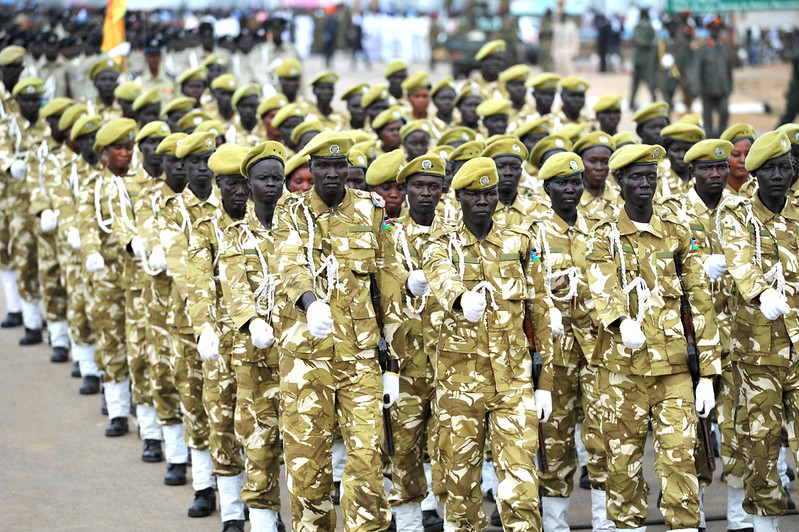
South Sudan national army parade at the 2nd Independence Anniversary of South Sudan- Juba, 9 July 2013
Since 2023 we have seen the outbreak of a civil war which has included many genocidal actions against Sudanese civilians. The two primary belligerents are the Sudanese Armed Forces (SAF) representing the government and recognised state of Sudan and the Rapid Support Forces (RSF) which is a militia that grew out of the notorious Janjaweed.
This conflict has not sprung up out of nowhere. The power and strength of both forces was a deliberate strategy employed by Omar al-Bashir, the dictator who ran Sudan for 30 years before being removed by the armed forces he hoped would protect him. Al-Bashir had witnessed the fall of Gaafar Nimeiry, the previous dictator, and led the coup d’etat which overthrew the civilian government that replaced Nimeiry. This meant that al-Bashir was very aware of the risks of the top office that needed to be addressed.
His strategy was to ignore and eventually come to support the growth of a militia in the north. This militia was called the Janjaweed which has been translated as meaning ‘devils on horseback’ which came from their origin of raiding villages on horses and camels in the 80s and 90s. The militia proved valuable to al-Bashir in the early 2000s. Due to wars in South Sudan (before independence) as well as on the border with Eritrea, the SAF were stretched thin across the country.
Therefore when new insurgent groups began in regions like Darfur and Kordofan, al-Bashir was happy to use the Janjaweed as a brutal force to repress the popular movements. Groups like the Sudan Liberation Movement/Army (SLM/A) started due to disproportionate representation in Sudan’s government by northern people who were normally descended from Arab tribes rather than from African descended tribes, a remnant of British rule.
The Janjaweed worked in conjunction with the SAF to commit a genocide in Darfur between 2003-2005. Hundreds of thousands were killed and millions faced displacement. These are the roots of both current belligerents and it should be clear that at this point they worked together to commit atrocities. Both SAF general Abdel Fattah al-Burhan and RSF commander Mohamed ‘Hemedti’ Dagalo are implicated in these crimes against humanity.
In 2005, war with South Sudan came to an end with the signing of the comprehensive peace agreement. With this, the genocide in Darfur lightened but there were still regular conflicts and deaths between 2005 and 2018.
In 2018, bread prices in Atbara tripled overnight which led to the first protests. These spread to the capital of Khartoum then quickly across the country. Demands to remove al-Bashir came and in 2019, he was removed from office and replaced with a transitional council consisting of military and civilian rule.
This government agreed to sign the Abraham Accords which worked to normalise relations with the genocidal state of Israel. The main incentive for doing this was the US agreeing to remove Sudan from the state sponsored terrorism list which imposed economic and political sanctions.
The transitional council lasted until 2021 when the SAF performed another coup against it and a military junta took control of the government, headed by al-Burhan. The RSF were not officially involved in the coup but it was reported there were many RSF members present in the capital to operate as additional security in case of protests of which there were many over the next two years.
The pressure of protests and protest deaths as well as calls for the RSF to be officially incorporated into the SAF were among the factors that led to the outbreak of fighting in 2023, which has been ongoing since and recently seen intensification in El-Fasher which the RSF captured in late October.
At this point, there is an obvious question to ask; where do the weapons come from?
Traditional military outfits like the SAF are government backed and therefore get their arms by the same methods as other governments. In the SAF’s case, they have received arms from lots of countries including Russia, China, Iran and Egypt.
The RSF don’t have the same state legitimacy and therefore require alternative methods of procuring weapons. Much of this is done through very tight connections with the UAE. The leadership of the UAE has a productive relationship with the RSF. They have employed the RSF as a force used against the Houthi forces in Yemen (which is partly why Hemedti has become a billionaire) as well as gained priority access to much of the gold that comes out of RSF controlled areas in Sudan. In return, the smuggling routes for extracting gold are used to bring weapons, personnel carriers and other military equipment back into Sudan.
The UAE is also a close trading partner with many western states including the UK and US. So close, in fact, that British made equipment has been found in the hands of the RSF. UK engines used in UAE built armoured personnel carriers were used by the RSF connecting Britain with the worst, ongoing humanitarian crisis. This is in spite of the fact that all involved companies claimed to follow regulatory procedure which includes a risk assessment for the likelihood of diversion to sanctioned states.
There are a few strategies that we should lean on when thinking about how to end this conflict and support the Sudanese civilian population.
This article has had more focus on the RSF rather than the SAF, in part because the RSF seems to be committing the worst of the atrocities, but also because it is more vulnerable to political pressure, specifically its arms supply. By focussing attention on the UAE as a primary supporter and facilitator of the RSF, we can associate the UAE brand with ongoing genocide.
We should incorporate the UAE into the boycott, divestment and sanction campaign. The BDS campaign is one of the cornerstones of the Palestine solidarity movement because it attacks the two things the psychopaths in charge care about, their money and reputation. The UAE relies on strategies like sport-washing to normalise its oppressive regime while peddling gold and weapons to fuel a genocide.
Do not go to Dubai. Do not eat the fancy, pistachio chocolate bar. Do not stay in hotels owned by UAE companies. Do not fly with Emirates airline. Do not buy tickets for teams that are owned by the UAE.
We should also recognise that showing solidarity with Sudan does not mean ignoring or taking away from Palestine. These arguments build on each other. Both are forms of modern imperialism attempting to steal land and resources from the civilian populations and both are intertwined by the regional stability of the Middle East and North Africa. There is a reason that Sudan and the UAE are two of the five countries that have signed the Abraham Accords.
Lastly, we should demand our government end all arms sales with a risk of diversion to Sudan. This should include a blanket ban on military equipment to the UAE. The companies involved all claim to have followed the regulatory requirements to export yet these weapons still flow into Sudan. Therefore, we should also advocate for a review of how our government licences weapons exports and how diversion risks are assessed.
While targeting the RSF supply is likely the quickest way to end this war, we should still hold both sides accountable for their crimes against humanity, including their roles in the Darfur genocide in the early 2000s and in the current outbreak of war.