
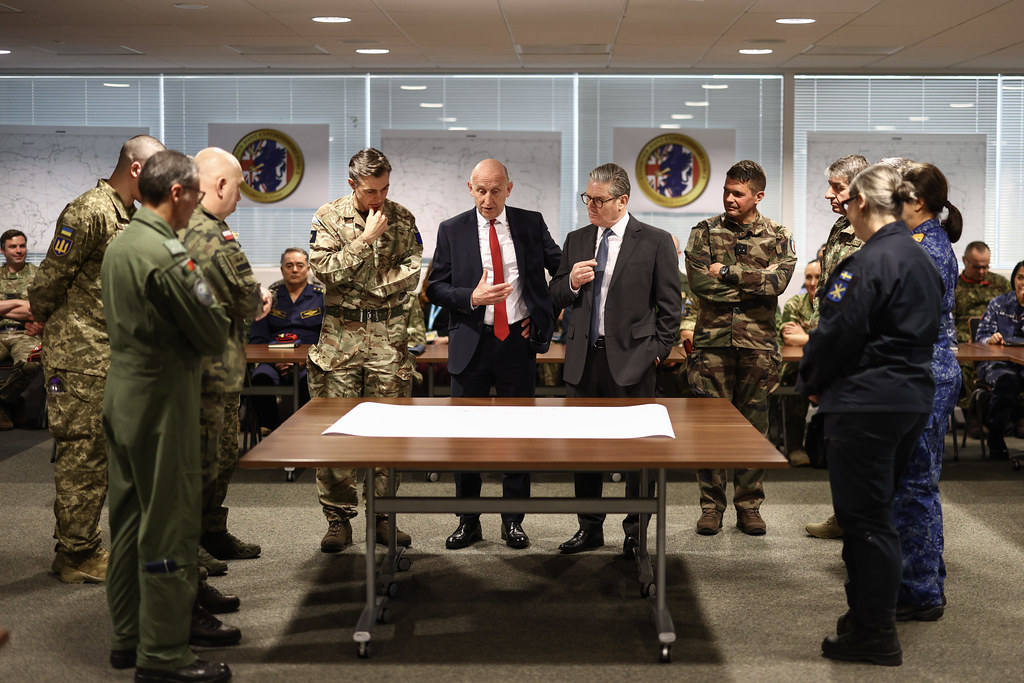
PM Keir Starmer and Defence Secretary John Healey visit the Permanent Joint Headquarters in Northwood, Simon Dawson / No 10 Downing Street
“We cannot defend Britain with an ever-expanding welfare budget,” the former Nato secretary-general and Scottish Labour MP said.
His message found support around the Cabinet table, including from Wes Streeting. The funding for military spending “has got to come from somewhere”, the Health Secretary said.
Writing in PoliticsHome, Scottish Labour MP Graeme Downie offered one suggestion: If young people “could be expected to die” for their country, pensioners should absorb the cost of sending 18 and 19-year-olds to their graves.
Remilitarisation is the order of the day, and the British ruling class agree that the public must pay for it.
It is worth dwelling on the ironic timing of these interventions. His call to impoverish swathes of the British population to fund war spending came as Donald Trump’s $1 trillion military proved just how ineffective putting guns before butter can be.
Washington’s latest Middle Eastern misadventure saw Iran, which spends just £8 billion on its defence, inflict a strategic defeat on the US despite its imperial hubris.
In Scotland, support for rearmament stretches across the political spectrum. When Starmer announced the “biggest sustained increase” in war spending since the Cold War, the Scottish Government affirmed its support for a rise in the ‘conventional’ military budget.
Indeed, First Minister John Swinney last year lifted his government’s restrictions on public funding for the arms industry. Three months later, the Scottish Finance Secretary unveiled ‘efficiency savings’ which will cut 11,000 public sector jobs before the end of the decade. With one hand, her government awards taxpayers’ money to arms companies reporting record earnings, with the other, St Andrew’s House prepares to hand P45s to Scotland’s workers.
In this context, it is hardly a surprise that the question of militarisation has barely featured in the ongoing Scottish election campaign. In his memoirs, the former foreign secretary Robin Cook noted that “the chair of BAE appeared to have the key to the garden door of No 10”.
Increasingly, the arms industry finds Bute House just as susceptible to its arguments. Scotland’s centrality to Britain’s ever-expanding war economy has been taken as read, accompanied by the promise of investment, growth and jobs.
The latter claim is particularly weak. Despite the constant flow of public money to the army industry, the Transition Security Project notes that more than half of the jobs in the UK’s military industry have been lost since 1980.
What’s more, in the 2024/2025 financial year, 56% of Ministry of Defence spending with British businesses went to London and the south of England, while nearly 40% of the £37.6bn military equipment budget was absorbed by 10 multinational companies. Just five of these top suppliers paid their shareholders £15bn in the 10 years to 2022.
The notion that a sector structured in such a manner could ever revitalise Clydeside industry is absurd, as only a cursory glance at the rate of deprivation in Govan – home to arms factories of BAE Systems and Thales – will illustrate.
“We’re under attack,” claimed Robertson – who is himself a lobbyist for American defence contractors – in Salisbury. He’s right. Working-class living standards are, indeed, under fire. Scotland’s public services are collapsing while wages fail to keep pace with inflation. Disindustrialisation plagues the east coast while healthy life expectancy falls across the country.
That’s all before considering the long-term impacts of Trump’s war on Iran, to which the UK, according to the IMF, is more exposed than any other advanced economy.
Robertson and his ilk propose to escalate this assault, inviting the most vulnerable to fund the bombs and bullets which decimate the lives and livelihoods of workers around the world.
‘National security’ has taken the place of ‘fiscal responsibility’ in excusing our politicians’ apparent refusal to invest in our cities, schools and hospitals.
Britain already boasts the world’s sixth-largest war budget – not that you’d know it. Indeed, the military has long been a sinkhole for public money.
Commissioned by Tony Blair’s first government, the Queen Elizabeth and Prince of Wales aircraft carriers, for example, were supposed to cost $2.7bn each. That figure, however, ended up closer to $12bn for both. The largest ships ever built for the Royal Navy, these vessels display the profound insecurity of post-colonial Britain and the fundamental myth of so-called ‘power projection’.
Even one former chief of the defence staff has described the “behemoths” as “unaffordable, vulnerable metal cans”.
It will come as little surprise to readers that Robertson played a leading role in this failed project as defence secretary after Labour’s 1997 landslide. Thirty years later, his appetite to throw good money after bad remains.
In spite of this disastrous track record, one should not underestimate the influence of Robertson’s intervention.
The Labour Government is weak, and Starmer is historically unpopular. He has already reached for the camouflage once to cement his authority, raising war spending to 2.5% of GDP from April 2027.
As the drive to war accelerates, he won’t think twice about doing so again.
This places an obligation on those who reject the insidious logic of austerity to reject the cry of remilitarisation when it comes not just from Downing Street, but closer to home too.

Source: The National