
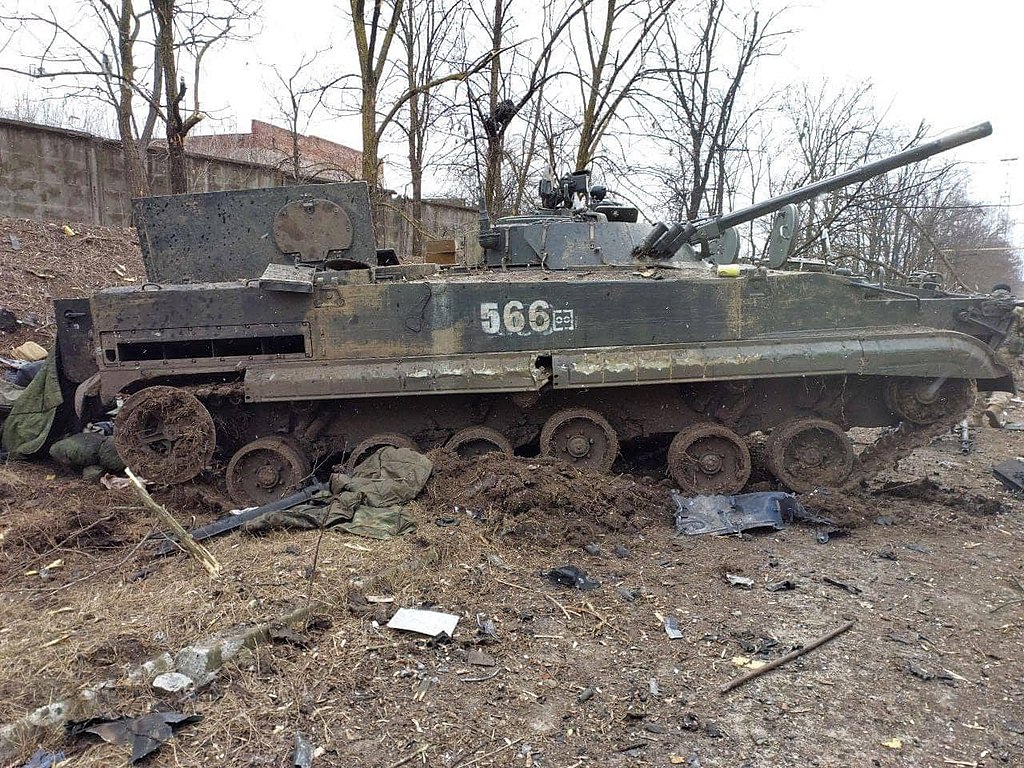
Destruction of Russian tank by Ukrainian troops
Over the last few months, there has been an increase in alarmist rhetoric from British officials. The MI6 chief declared that “the frontline is everywhere”, the head of the British armed forces urged the “whole nation to step up” in readiness, and Defence Minister Al Carns warned of the inevitable “shadow of war” looming over Europe.
This rhetoric is mirrored by sensationalist statements from the media. The BBCasked, “How long could Britain really fight if war broke out tomorrow?” LBC host James O’Brien proclaimed, “We are already at war with Russia,” and a headline from the Sun reads, “Britain will pay with blood if it doesn’t take Putin’s WW3 warning seriously…”
These quotations show an undeniable appetite for confrontation with Russia within our political and media class, and an attempt to create war fever in Britain. The language of an omnipresent frontline and the prospect of British blood being spilled in the future is designed to create an atmosphere of national insecurity. As a narrative with very little in common with material reality, it functions as consensus-building for a more hawkish foreign policy and increased military spending.
The narrative collapses with minimal scrutiny. Economically, Russia isn’t a peer competitor to any major NATO country like the US, Germany or Britain. Its economy is smaller than Italy’s and comparable to that of Spain; it becomes even more dwarfed if one takes into consideration of the whole of NATO combined. In 2024, Russia’s military expenditure (with an active full-scale war being waged) was 5.5% of the world’s total defence spending; NATO accounted for 66% of the entire world’s military spending.
Militarily and geographically, the picture is no different. Russia lacks the ability to secure a strategic victory against NATO in any conventional scenario. After almost four years of war, the country has failed to subdue Ukraine, one of the least developed states in Europe. According to the Institute for the Study of War, it has gained less than 1% of Ukrainian territory since the beginning of 2025. The suggestion that the Russian military can threaten Poland, Germany or even the UK is political myth-making.
However, this does not mean to say that war with Russia would be easy, limited or without consequence. Any such conflict would wreak a devastating toll on the working classes in Europe, not least because of the ever-present risk of nuclear escalation. Even short of that threshold, any war would mean mass deaths, economic collapse and increased repression at home. These costs are borne most by people with the least power to influence decisions.
British officials are not alone in stoking escalation. Across Europe, senior political and military figures have adopted increasingly extreme rhetoric. France’s top army chief has warned the public to be prepared to “lose their children”, while NATO General Secretary Mark Rutte, has urged Europeans to ready themselves for wars on the scale of the twentieth century. Even more alarmingly, the chair of NATO’s military committee has floated the idea of ‘defensive’ pre-emptive strikes. Such statements signal not deterrence, but the normalisation of war as a political horizon.
This escalation is no longer confined to rhetoric. Across Europe, militarism is being embedded into everyday life through the expansion of conscription and compulsory national service. Since 2020, countries including the Netherlands, Poland, and Bulgaria have moved towards forms of mandatory military service, while Germany, France, Belgium, and Romania have announced plans to introduce or expand national-service schemes. Croatia has now reinstated compulsory service, becoming the ninth NATO member to do so. These measures represent a significant shift towards the mass mobilisation of society for war, normalising the expectation that working-class youth should be prepared to lay down their lives.
The drive towards confrontation with Russia is not rooted in material reality, but in political choice. A largely fictitious external threat is being inflated to justify militarisation, rising defence budgets, and the remaking of European societies around permanent preparedness for war. For working people, this means conscription, austerity, repression, and the growing expectation that they should sacrifice their lives for conflicts over which they exercise no control.
Resisting this militarism begins with rejecting the narratives that present war as inevitable, and with building a sustained opposition that prioritises human need over geopolitical rivalry and profit. A historical guide for such resistance comes from the anti-war resolution adopted at the Second International in Stuttgart in 1907, where socialists committed to “exert every effort in order to prevent the outbreak of war”, and, should war occur, to “intervene in favour of its speedy termination.” The lesson of Stuttgart remains clear: socialists must resist being co-opted by national governments, as many were in 1914, and instead oppose the drive to war in principle, defending working-class lives and international solidarity above all else. Practical examples of contemporary resistance, such as Italian dock workers’ refusal to handle military shipments, show the continued relevance of grassroots action.
For more guidance, see the model motion from the London Peace Conference, June 2026, which outlines concrete ways to build anti-war campaigns today.
Source: Counterfire