
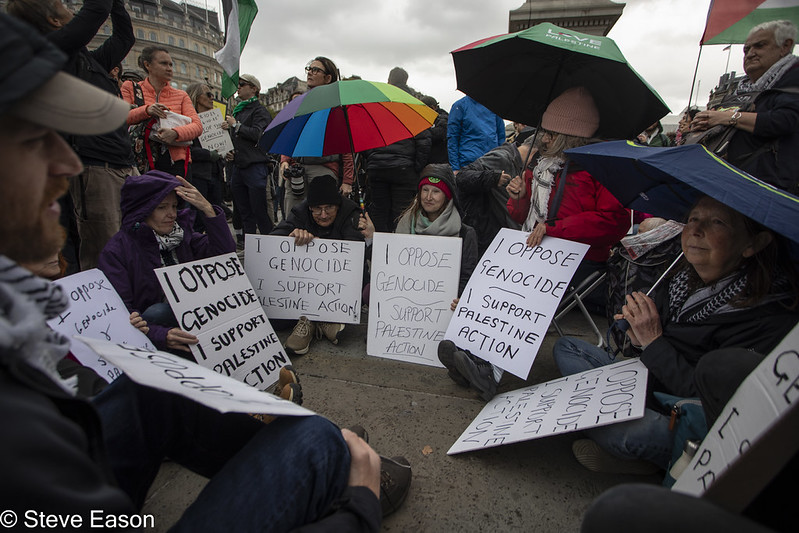
The Metropolitan Police Service (MPS) arrested pro-Palestine activists against its own internal guidance, documents seen by Declassified suggest.
The files, obtained through Freedom of Information requests, also show that the force is cracking down on the use of Arabic words far beyond its controversial policing of the term intifada.
The information comes from two versions of MPS “guidance” advising officers on what constitutes grounds for arrest at Israel-Palestine protests.
One version is from July 2025, shortly after Palestine Action was proscribed, while the second is from December 2025 after the Bondi Beach and Manchester synagogue attacks.
The version from July specifically states that calling for de-proscription of a group does not ‘itself’ suggest membership or support of a proscribed organisation.
Alongside a photo of a protester with a placard that says “Home Secretary, De-Proscribe Hezbollah”, the guidance says: “Holding the sign alone will not likely amount to an offence”.
But Declassified has identified a man who says the Met has arrested him three times since last January for holding a placard calling for the de-proscription of Hamas, Hezbollah, and Palestine Action.
The December version places a much heavier emphasis than the earlier guidance on investigating words in Arabic, with full pages dedicated to single words not covered at all in the earlier guidance.
Jonathan Purcell, spokesperson for the International Centre of Justice for Palestinians, said the “whack-a-mole” policing of languages “smacks of a racist association of the Arabic language with violence, when in fact these are calls for liberty and freedom”.
It’s a legal right in the UK to criticise the government’s decision to ban a group and to call for de-proscription.
The MPS acknowledged this in its internal guidance from last July, the same document which says that holding a sign calling for de-proscription alone does not suggest membership of a proscribed organisation and that individuals have to actively express support for a proscribed group for this to be an offence.
The force has nevertheless repeatedly prevented protesters from exercising these rights, although it’s unclear just how many have been arrested for this.
In October, a sign-holder at a protest in Trafalagar Square in London was arrested under the Terrorism Act for allegedly displaying a sign which said: “I do not support the proscription of Palestine Action.”
“This is a police state,” she said while being led away by police. “Anything is possible in this country apparently. I don’t recognise it anymore.”
The MPS told Declassified that she was “de-arrested” sometime after.
Asked about the arrest later that month, Police Commissioner Sir Mark Rowley told members of the London Assembly: “When people are playing games with the law and trying to step right up to the line, then it is not impossible to make mistakes.”
Rowley claimed protesters had held placards saying “I support Plasticine Action”, hoping that officers did not read them closely and would arrest them.
“There have been some silly games played and, of course, under pressure, sometimes officers might get that slightly wrong, but . . . we are always learning from the past ones and some of the games that some of these protesters are playing,” he said.
The government’s independent reviewer of terrorism legislation, Jonathan Hall KC, told Declassified he believes that while people “are free to express their opposition to terrorism proscription,” this is not “always straightforward” for the police in live situations.
“Imagine a banner appearing to support an extremely violent terrorist organisation: using the word ‘deproscription’ is not necessarily a get-out-jail-free-card, and it might rightly attract the attention of police.
“But if people cannot conscientiously say that they disagree with government decisions, then that would be terrible, and the police just have to take care in these situations,” he continued.
Hall said issues surrounding calls for de-proscription will be discussed in his next annual report.
Michael*, a retiree from north London, says after three arrests by the MPS for holding placards calling for the de-proscription of Hamas, Hezbollah, and Palestine Action, he’s started advising police officers with his own crib-sheet to prove it’s not a crime.
“This hostile action to criticism of Israel or support for Palestinian rights is very confrontational. I think it’s politically directed. They obviously have a direction that they should not be soft on demonstrators,” he said.
After his first arrest last January, he says counter-terror police interrogated him about his “relationship with Hamas” and how he had managed to “keep in contact” with them.
He said he has no relationship with Hamas, nor any political groups in the UK, and that while he does “belong to the local library, that’s as racy as it gets”.
Michael said he was arrested again in July and a third time in October over his signs, but was never charged.
On another occasion, he was detained, but not arrested. He said he was told: “Put it this way, wherever you go, we will be there too.”
“I took that as intimidation and left pretty quickly after that,” Michael said.
The impact of his arrests has been “profoundly unsettling”, not just on his family and social life, but also on his everyday life: he was temporarily barred from volunteering, the “main feature” of his life these days.
“I’m a marked man,” he said.
The proscription of Hamas’ political wing was controversially applied withouta parliamentary vote, while Hezbollah’s followed heavy lobbying from the Conservative Friends of Israel.
Palestine Action’s ban was also ruled unlawful by the High Court last month but the Home Office is challenging the decision.
Michael said he will continue to protest the “unconscionable” ban of these groups despite his encounters with the police.
In correspondence with Declassified, the MPS attributed these mistakes to the fact that officers are called in from all across policing, not just public order, and can’t all be expected to remember “every nuance” of the guidance given to them.
The guidance shared with the police in December 2025 shows how advice on use of the word ‘intifada’ abruptly shifted following the attacks on Jewish communities in the UK and Australia.
Intifada is an Arabic word literally meaning shaking off or, in a political context, uprising against injustice.
The July guidance suggests that “chants talking about an intifada could be an offence if the wording leads the officer to believe it is calling for a violent uprising”.
It then points out that the Crown Prosecution Service (CPS) contends that use of the word “is an expression of political support for Palestine and does not have negative racial connotations”.
When asked by Declassified if this position has changed, the CPS said it couldn’t comment on individual words.
Yet days after the Bondi Beach attack killed 15 people, the MPS and Greater Manchester police forces announced that they would arrest people for chanting “globalise the intifada” or holding placards displaying the phrase.
Internally, MPS officers were told they would “be expected to take decisive action” if “globalise the intifada” was found on a placard or chanted at protests because it carries “a real risk of stirring up antisemitism”.
The force are advised to investigate “what the person means” when they use the term intifada alone, including questioning individuals to figure out why they’ve used it.
The December guidance also goes beyond concerns over the word intifada, suggesting that the terms inqilaba (revolution) and muqawama (resistance) should be investigated and could be an offence if the police perceive those using the words are calling for the destruction of Israel, or implying support for Hamas.
The MPS acknowledged that, when said in the context of supporting self-defence, they aren’t offences.
But it’s unclear how this can be enforced: the MPS is primarily staffed by English-speaking officers, and although Arabic-speaking officers are available for significant protests, it seems the messaging in the guidance documents could impose a chilling effect on protests.
Zena Agha, interim director of the British Palestinian Committee, said the documents empower the government and police to “dictate whether individuals expressing their right to protest are criminalised”.
“[They] lay bare the anxiety that the police, acting on behalf of the government, have with regards to curtailing not just the right to protest but what can be said or expressed in support of Palestinian freedom and self-determination,” she said.
While no arrests appear to have been made in relation to these words yet, there have been arrests over the alleged use of intifada.
On 17 December, three individuals — Haya Adam, Azza Zaki, and Abdallah Alanzi — were arrested for allegedly chanting for an intifada at a protest in London.
They were charged under the Public Order Act for “using threatening words and behaviour” where “racial hatred was likely to be stirred up”, according to the CPS. The three have pleaded not guilty.
In the December guidance, police officers were further told, in the context of investigating chants perceived as anti-semitic, to seize people’s phones and search for content that could back this up.
Both pieces of guidance also advise that chants saying Yemen, Lebanon or Palestine “you make us proud, turn another tank around” could be interpreted as euphemisms for supporting the Houthis, Hezbollah and Hamas.
The chants referring to Lebanon or Palestine “must be assessed in the specific context” but might violate the Terrorism Act or public order laws.
Nick Glynn, a retired police officer and board member of Independent Scrutiny and Oversight which monitors police racism on behalf of the National Police Chiefs’ Council, said this equivocation is wrong, and a “dangerous but commonly used trope” to silence opposition to the “ongoing genocide”.
He also described, in reference to the documents as a whole, a potential “chilling effect” on protest as a result of their “biased” and “one-sided” framing.
The MPS has also allegedly begun seeking advice about Bobby Vylan’s “death to the IDF” chant at a recent protest, despite the more recent guidance saying it has to be “more” than simply chanting “death to the IDF” to be an offence.
The force would not confirm if it was indeed the rapper and activist who was under investigation.
*His name has been changed to protect his identity
Source: Declassified