
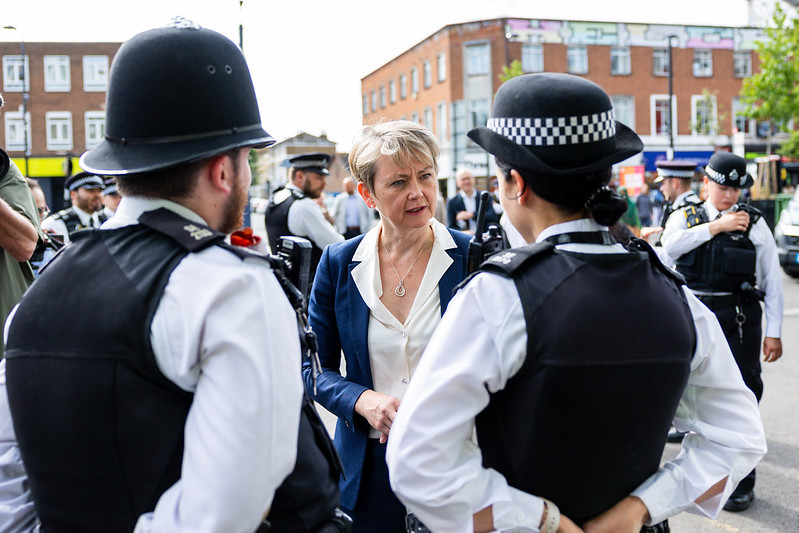
Picture by Andy Taylor / Home Office.
Yvette Cooper isn’t wrong, the Iranian government should allow peaceful protests. But given the level of repression being meted out by her government on the Palestine movement, including her proscription of Palestine Action resulting in thousands of arrests under anti-terror laws of people peacefully holding up placards, the justice secretary’s refusal to allow bail for the Filton 24 hunger strikers, and that further draconian restrictions on the right to protest are currently working their way through parliament, it’s a reminder that no one does hypocrisy quite like the British government.
Or maybe the US government does. For while US president Donald Trump and his vice-president JD Vance have been threatening intervention, including airstrikes, to protect the Iranian demonstrators, in the same breath they’ve called for the suppression of protests across the US sparked by the killing of Renee Nicole Good, and branded those demanding ICE get off the streets as “domestic terrorists”.
For Trump and Cooper, human rights abroad count for far more than those at home.
It’s claimed by some that the Iranian government initially sought to engage with the traders protesting against the spiralling cost of living crisis. Whether it did or not, we’d certainly expect our government to do so when we and other civil society and labour movement organisations campaign and rally against the cost of living crisis here and welfare cuts to pay for increased military spending.
Although, with the measures contained in the crime and policing bill allowing the police to crackdown on perceived “cumulative disruption” of demonstrations caused by repeat protests in a given area or even (it is still unclear) on the same issue, we can probably expect no such thing.
And today the home secretary Shabana Mahmood won a vote in parliament to make non-violent demonstrations at animal-testing facilities a criminal offence. Where will the repression end?
Let’s not also lose sight of the fact that the economic crisis and distress in Iran and the sharp fall in its currency are largely the result of or escalated by the West’s illegal sanctions on the country. Many of those protesting recognise this and understand Trump is not their friend, with mass protests carried out in cities across the country to reject the US threats and to call for national unity and an end to the escalatingly violent nature of some of the demonstrations.
The vast majority of Iranians are opposed to regime change by the West, whatever their complaints about the regime.
Nevertheless, the foreign secretary made a statement in parliament on Tuesday boasting that the government had imposed over 220 Iran sanctions designations since coming into office.
She said: “And we are backing strong sanctions enforcement. Just last week, the UK provided support to the US’s seizure of Bella 1, accused of shadow fleet activities and Iran sanctions breaches.”
Much of the Western media coverage has of course failed to note this in relation to the impact on the Iranian economy, or that some of the protests did see houses, mosques and other civilian and public buildings come under attack, with the Iranian armed forces minister describing “armed mercenaries” killing civilians and law enforcement officials. The authorities say they believe foreign countries, including Israel, are behind the unrest sweeping the country – and are involved in fomenting it on the ground.
It’s certainly the case that Israel’s far-right minister Amichai Eliyahu gave a radio interview in which he boasted of how Mossad agents laid the groundwork for a strike on Tehran while on Iranian soil last summer during the 12-day so-called ‘Rising Lion” conflict.
“I can assure you that we have some of our people operating there right now,” he said.
And former US Secretary of State Mike Pompeo, also a former director of the CIA, tweeted on 2 January: “Happy New Year to every Iranian in the streets. Also to every Mossad agent walking beside them.”
These agents, Mossad or otherwise, are not of course the majority of protesters. But they do use genuine protest for their own ends. Whatever the truth of the extent of their provocation, it’s clear that the West is engaged in a campaign of destabilisation and building public support for military action against Iran, a country it deems an enemy, in part because of the regime’s support for Palestine. The anti-war movement in Britain can best show solidarity with the working class people of Iran by opposing it.