
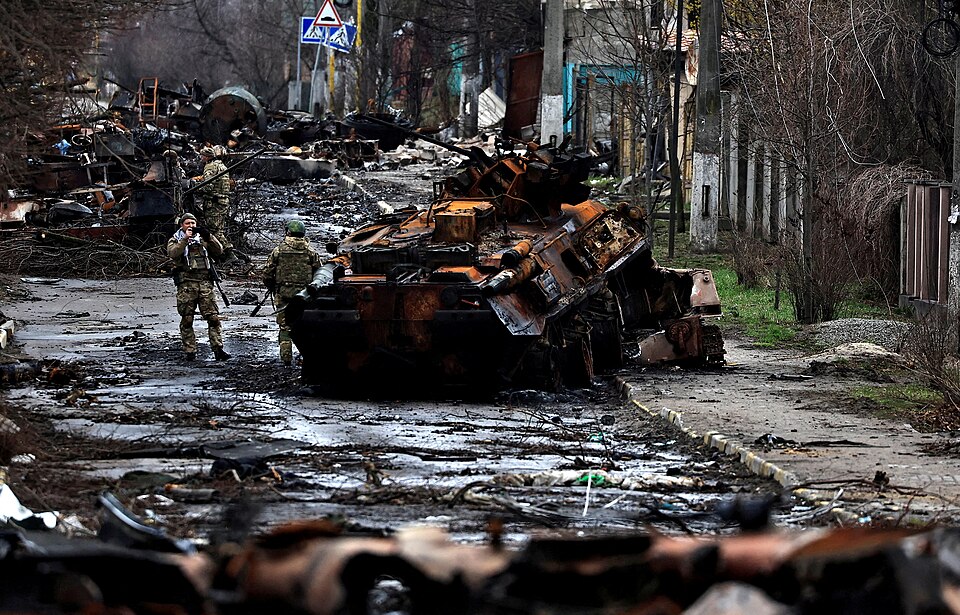
It is four years since Russia invaded Ukraine, intensifying a conflict that has now cost hundreds of thousands of lives in a dystopian, attritional war which has further imperilled wider world peace.
It is a conflict which the British government, under both Labour and Tories, has worked every day to keep going. That has been the main conditioning feature of Stop the War’s work since the war broke out – campaigning for peace in the face of British efforts to prolong war.
We condemned Putin’s invasion on the day it happened and have maintained that opposition since. It was an act clearly in breach of international law and animated by a Russian nationalism which shows scant respect for Ukrainian identity and sovereignty.
Whilst reacting to real problems and provocations, it has been a massively disproportionate response which, in addition to the lives lost and wrecked, and the economic devastation caused, will poison Russian-Ukrainian relations for decades to come.
Nevertheless, it is not the simple Manichean conflict described in western propaganda. In reality, it is three wars in one.
The first, running hot from 2014 and the Maidan coup against the elected government in Kyiv and simmering before that, is a civil conflict in Ukraine between Ukrainian nationalism, generally pro-western, and the very large ethnic Russian or Russian-speaking minority in the south and east of the country.
Competing corrupt oligarchic groups have structured Ukrainian politics around that binary since the end of the Soviet Union, failing to create a unified democratic politics while obstructing the emergence of class politics. The 2014 coup sharpened that conflict, leading not just to the Russian annexation of Crimea but the ascendance of a strident Ukrainian nationalism that does not hesitate to venerate nazi collaborators.
That, together with an official assault on the use of the Russian language, has terminally alienated many millions from the Ukrainian state, which inherited arbitrary Soviet-drawn borders.
The second war is the state conflict between Ukraine and Russia. President Putin failed in his initial attempt to overturn the Kyiv government and install one subordinate to his own authoritarian nationalist regime.
Since then the war has been fought in the east and the south of the country. Nearly all Russia’s military gains were made in the first weeks after the invasion in 2022. It has since shown no capacity for a strategic breakthrough and has failed to secure either air superiority or control of the Black Sea.
Ukraine launched a failed counter-offensive in 2023 and has at no time since held the military initiative. Hence the prolonged stalemate, marked by very slow Russian advance bought at the cost of immense losses of young lives.
Putin’s demands for ending the conflict appear to pivot on securing the transfer of the significant part of Donetsk province which he has not conquered militarily to Russian control. Russia already has full control of Luhansk, and appears ready to settle for what its army already holds in Kherson and Zaporizhzhia provinces. These are the four regions (beyond Crimea) which Russia has unilaterally annexed.
This is dressed up as concern for Russian speakers. Yet there would be millions still outside Russia’s borders even if peace were secured on Putin’s terms, and indeed some Russian nationalists lay claim to a further four Ukrainian provinces – Mykolaiv, Kharkiv, Odesa and Dnipro – in which Putin officially evinces no interest.
The fate of all disputed territories should be settled by the democratic will of the peoples living there. However, it must be acknowledged that the conditions for such a democratic resolution do not exist at present, and likely will not for a considerable time to come.
The third aspect of the war is its proxy element. It is this which has prolonged and frequently risked ruinous escalation of the war. And it is this which Stop the War has focussed on, since it directly involves the foreign and military policies of the British government.
A major factor in the outbreak of war was the extension of NATO, which has already reached Russia’s borders in the Baltic region, and has embraced many eastern European states, in breach of commitments made at the end of the Cold War.
NATO is an instrument of the aggressive expansion of US and imperialist power. Under its banner wars have been fought in Yugoslavia, Afghanistan and Libya. No Russian government could possibly see its extension deep into former Soviet territory as anything other than a threat.
The determination to bring Ukraine, a far larger country than the Baltic republics, into NATO was a provocation, particularly when allied to a virulently anti-Russian government in Kyiv.
Once conflict broke out, NATO did all it could to stop a peace deal being negotiated. Weakening its Russian rival took priority, the more so since behind Russia stands China. Together they present a threat to continuing western world hegemony. The war was an opportunity to bleed and isolate them.
This feature has led the British government to intervene consistently to keep the fight going, supplying every form of military, political and financial assistance to Ukraine, including the undisclosed deployment of British forces.
The British government has been more bellicose than either the Biden or Trump administrations in Washington. This reflects its desperation to maintain the present world order, including NATO’s military domination, from which it benefits so mightily.
However, most of the world’s states have refused to be dragooned by the US and its allies into supporting the war and breaking with Russia. In that sense, the war has highlighted the demise of western hegemony rather than its fresh assertion.
This has not led to any second thoughts in official London. Rather war rhetoric has been ratcheted up, with the public being conditioned to the inevitability of conflict with Russia, despite the lack of any basis for such a war in either Russia’s intentions or capacities.
And it is the justification prayed in aid by ministers for the massive projected increases in military spending, which will beggar the public realm for years to come.
Now Defence Secretary John Healey is champing at the bit to deploy British troops to Ukraine as part of any peace deal, even though that would mean simply bringing NATO into the region under another flag. This is almost bound to be unacceptable to Russia – it is another device to prolong the war.
Stop the War continues to oppose this platform. We cannot write a peace deal between Ukraine and Russia, nor resolve the internal strife within Ukraine, nor make the Russian government as good as it ought to be.
We can and do oppose the British government’s reckless policy on the war, its willingness to promote the continuation of a slaughter, its arming and financing of the war, its proposal to deploy British troops and its squandering of billions on an unnecessary arms build-up.
The urgent need today is to win wider sections of opinion to support these demands and halt the slide to a third world war of incalculable and surely unmanageable consequences. More than ever, we must stop the war.