
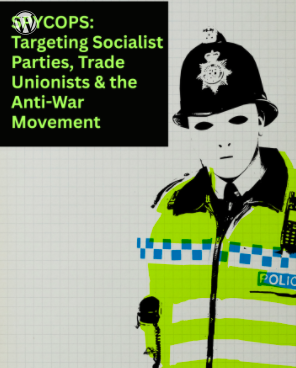
Paul Heron reports on the latest developments at the Undercover Policing Inquiry and outlines the Position Statement filed with the Inquiry on behalf of Lois Austin, Joe Batty, Lindsey German, Dave Nellist, Chris Nineham, John Rees and the Stop the War Coalition
For more than four decades, Britain’s undercover political policing units claimed they existed to prevent serious disorder, subversion and threats to public safety. Our Position Statement[1] based on the limited evidence that has been disclosed by the Inquiry in Tranche 3 Part 2 suggests something very different. The British state, supported by successive Governments, directed undercover officers (UCO) to sustain a covert campaign not against crime, but against ideas.
Our Position Statement filed on the 21st January 2026, submitted to the Undercover Policing Inquiry (UCPI) shows undercover officers infiltrating socialist parties, monitoring leading Marxists, mapping trade union influence and embedding themselves inside the anti-war movement. The Undercover Officers (UCOs) targets were not violent conspirators. They were election candidates, shop stewards, workplace organisers, peace campaigners and campaigners for socialism.
Our Position Statement prepared on behalf the clients we represent argues bluntly that what took place was “ideological targeting rather than crime prevention,”[2] placing these operations “outside the bounds of lawful and proportionate policing”[3]
Infiltrating the socialist parties and the Marxist left
Two organisations were subject to especially intensive surveillance: the Socialist Workers Party and the Socialist Party. Both are long-standing Marxist organisations active in elections, trade unions and social movements.
Yet even internal police records, as our Position Statement notes, admits there was no credible public order or subversion case for infiltration. By the late 1990s, the SDS had already conceded the Socialist Party was “ostensibly committed to parliamentary democracy”[4], a finding that should have ended political policing. Instead, deployments were stepped up, and continued for years
Carlo Soracchi (HN104) infiltrated the Socialist Party from 2000 to 2006. Another officer, operating as “Simon Wellings” (HN118) infiltrated the SWP and associated campaigns from 2001 to 2007.
As our Position Statement makes clear, the problem was not mistaken intelligence but a deeper institutional mindset. After decades of reporting, that failed to uncover serious criminality, the police “knew that they were unjustified”.[5] The question posed to the Inquiry is stark: “Why, despite that knowledge, did the infiltrations continue? What was the real rationale?”[6]
Monitoring named Marxists and Trotskyists
The surveillance was both organisational and it was personal.
Reports tracked the movements and internal discussions of senior activists including Lois Austin, Hannah Sell, Chris Nineham, Lindsey German, and John Rees, activists known primarily for public campaigning, organising not criminal conduct.
Internal undercover police documents detailed election strategies, Coalition talks, and political meetings. Officers reported on plans to stand candidates, discussions about parliamentary tactics, and efforts to coordinate with other left-wing parties to avoid splitting votes.
One report even acknowledged that “the main priority of the Socialist Party remains firmly committed to the electoral process,”[7] before nevertheless suggesting this might somehow “precipitate the revolution from within the system”[8]
In other words, participation in democracy itself became suspicious.
From public order to ideology
Throughout the files, disclosed by the Inquiry, runs a recurring pattern: the language of disorder without the reality.
Peaceful lobbying was reframed as “harassment”.[9] Routine protest planning was described as preparations for unrest. Leaders were falsely said to be “hoping that serious disorder [would] break out”.[10]
Yet time and again, demonstrations passed peacefully.
Our Position Statement calls this a long-standing SDS habit of “exaggerating or fabricating intelligence”[11] to maintain “an illusion that they were attempting to comply”[12] not only with legal standards, but always to justify the intrusion and reporting.
The effect was political as much as operational. False intelligence, it argues, “inevitably shapes how the police, the government and the media respond,”[13] allowing the state to “manipulate narratives and suppress dissent”[14]
Perhaps the most revealing admission came from a senior Special Branch commander interviewed years later. He described the unit’s purpose not simply as gathering information but to “influence” and to “disrupt from within”.[15]
It is a strategy that is not only all about political policing, but additional a deliberate strategy of de-railing genuine political campaigning
Targeting the anti-war movement
Nowhere was the gap between justification and reality clearer than in the treatment of the Stop the War Coalition.
Founded after 9/11, the Coalition became one of the broadest protest movements in British history. It brought together trade unionists, faith groups, MPs, civil liberties organisations and campaigners across the political spectrum. Its marches especially the February 2003 demonstration against the Iraq war, were historic in scale.
“They were characterised by their orderly and peaceful nature,”[16] as we state in our Position Statement records, and “meticulously and openly planned, with regular liaison with Police, and contingents of stewards that, for the larger demonstrations, numbered in their hundreds”[17]
Despite this, undercover officers infiltrated the leadership and repeatedly reported alleged riot planning that never materialised.
When disorder failed to occur, explanations were invented after the fact.
Officers also produced detailed reports on the Coalition’s offices, security and membership systems. In one instance, after intelligence about office arrangements had been supplied internally, burglars stole computer hard drives containing membership lists. The report noted the loss would be “…a significant blow to the effectiveness of the Coalition.”[18] You don’t have to be a genius to wonder who stole those hard drives.
Watching the unions
If anti-war protests drew scrutiny, trade unions drew sustained attention.
The briefings from the undercover officer Carlo Soracchi focused extensively on what police termed “militant trade union activity”. Detailed analyses were prepared on Socialist Party involvement in the trade unions of UNISON, PCS, the Fire Brigades Union, the RMT and others. These documents described leadership contests, strike preparation and organising drives.
They contained no serious crime.
Nevertheless, the reports were circulated to the Security Service, the Cabinet Office and Downing Street. According to internal summaries, some “attracted high praise from Cabinet Ministers” [19]
Our Position Statement notes the contradiction with Home Office guidance that “industrial militancy is the use or threatened use of strikes…[and] should not be confused with subversion”.[20] Yet in practice, lawful union activism was treated as an intelligence requirement.
As we have stated in our Position Statement, “There can be no doubt that Soracchi’s reporting was significantly focused on militant trade union activity throughout his deployment”[21]
Interfering with justice
Another troubling allegation concerns the courtroom itself and an apparent interference in justice.
In 2005, Socialist Party activist Lois Austin brought a claim against the Metropolitan Police after protesters were kettled at Oxford Circus on May Day 2001. A case that ultimately went to the European Court of Human Rights. Carlo Soracchi had been inside that kettle posing as a fellow activist.
Internal records show that days before the High Court hearing, he met with a barrister representing the police and “provided background information”[22] to the defence. The document adds: “To my knowledge never done before by SDS field officer”[23]
The Metropolitan Police (MPS) won the case, both domestically and in Europe. But serious questions remain.
If an undercover officer embedded within a claimant’s political organisation was briefing the defendant’s legal team, the implications are profound. It suggests not merely surveillance but potential interference with due process. It is something we will be raising during this Phase of Tranche 3.
This is a case that was won by the MPS but was built on questionable foundations.
A political choice
Taken all together, the evidence points to something systematic.
Peace groups, Marxists, socialists and trade unionists were infiltrated not because they planned violence but because they were effective, because they organised thousands, in some cases hundreds of thousands, challenged government policy and threatened to reshape public debate.
As the submission concludes, these were “lawful expressions of political belief and democratic participation, posing no threat that could rationally warrant undercover infiltration”[24]
The story that emerges is not of rogue officers but of an institutional view that socialism itself constituted a risk.
If the Inquiry confirms that conclusion, it will mark one of the most significant findings in modern British policing history: that the state’s covert apparatus was turned not against crime, but against dissent.
And that, in the end, the ideology under surveillance was democracy itself. As we concluded in our submissions to Tranche 1:
“In their defence the British establishment claimed to be defending democracy, but it was not a defence of democracy, it was the undermining of democracy in defence of the establishment.”[25]
[1] The Position Statement was submitted on the 21st January 2026 behalf of Lois Austin, Joe Batty, Lindsey German, Dave Nellist, Chris Nineham, John Rees and the Stop the War Coalition. The PILC legal team comprises, James Scobie KC (Garden Court Chambers); Piers Marquis (Doughty Street Chambers) and Paul Heron (Solicitor)
[2] p21
[3] Position Statement – p21
[4] MPS-0527564/14
[5] Position Statement p.3
[6] Position Statement p.3
[7] MPS-0035343
[8] MPS-0035343
[9] MPS-0721324/5
[10] Position Statement p.7
[11] Position Statement p.6
[12] Position Statement p.6
[13] Lindsey German T3 rule 9 statement p44
[14] Position Statement p.12
[15] Position Statement p.10
[16]Position Statement p.9
[17] Position Statement p.9
[18] MPS-0022229
[19] MPS-0722146/66
[20] UCPI0000004584/2 paragraph 7: “Subversion should not be confused with industrial militancy. Industrial militancy is the use or threatened use of strikes, sit-ins or other disruptive action in the furtherance of industrial disputes, and an unwillingness to seek or accept compromise solutions through negotiations, conciliation or arbitration. The actions of industrial militants only become subversive when their intent is to threaten the safety and well-being of the State and to undermine or overthrow Parliamentary democracy”
[21]Position Statement p15
[22] MPS-0721992
[23] MPS-0071194
[24] Position Statement p.21
[25] Closing submission for Tranche 1 of the Undercover Policing Inquiry on behalf of: Richard Chessum, ‘Mary’ and Lindsey German p.74
Source: PILC