
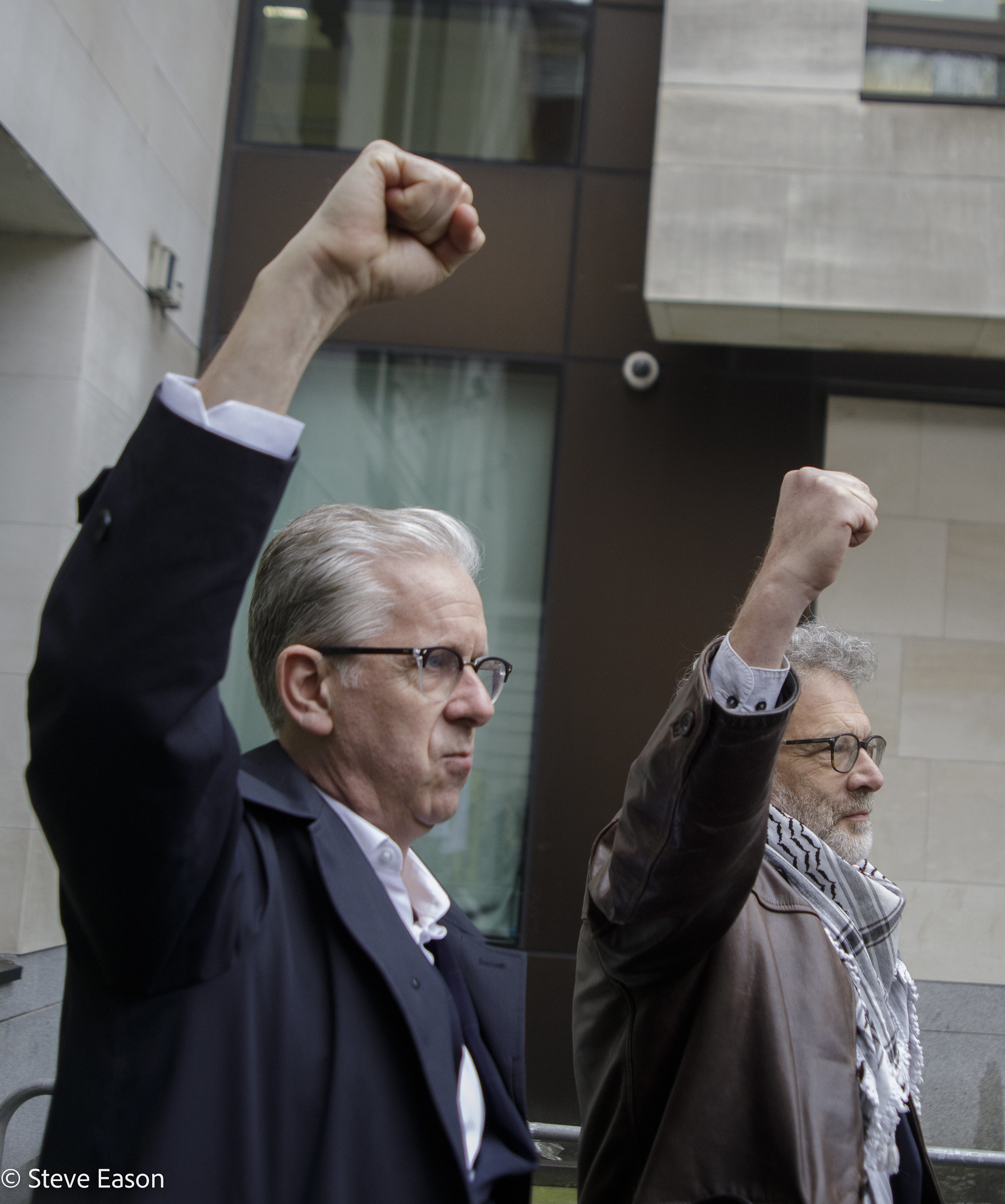
Four days into the trial of Stop the War vice-chair Chris Nineham and Palestine Solidarity Campaign director Ben Jamal on public order offences arising from a peaceful Palestine protest in Whitehall on 18 January 2025, the case has been adjourned for seven days to enable the prosecution to consider the defence’s legal arguments to have the case thrown out on the grounds that there is no case to answer in law.
But it’s worth outlining what’s happened so far at court, given that the case represents part of the wider attack on the right to protest.
To understand why Chris and Ben’s defence barrister Mark Summers KC submitted the application to have the case thrown out, we can go back to the first day of the trial, when Mark Summers set out three grounds on which the judge should acquit.
The case referred to is Liberty v Secretary for the Home Department, when in May 2024 the High Court ruled that regulations introduced in 2023 by the former Home Secretary Suella Braverman into the Public Order Act 1986, were unlawful. These regulations introduced the concept of “cumulative disruption” and lowered the threshold for police to intervene in protests from “serious” to “more than minor” disruption.
Gold meetings
Proceedings continued with prosecution barrister Kevin Dent KC calling Commander Slonecki to recount his witness statement and logs of events leading up to his decision not to allow the Palestine Coalition to assemble at BBC Portland Place for the national demonstration on 18 January.
Summers cross-examined him and during that exchange Slonecki accepted that the 21 marches (as the tally stood then) for Palestine marches over the previous 15 months had been lawful, peaceful and orderly. He agreed that this was an unprecedented achievement.
The court heard that the police had agreed to the route of the march and its public announcement during a meeting with the Coalition in November 2024. This was after the Coalition had accepted a police request to postpone a planned march from the BBC on 30 November 2024 mainly due to the concerns of retailers (it would have fallen on the Black Friday weekend) on the understanding it would go ahead in January 2025.
However, after receiving a number of arguments from representatives of some sections of the Jewish community from 13 December, including the Jewish Leadership Council (JLC), Central London Synagogue and the Chief Rabbi, none of which were logged by Slonecki at the time, he had, by the 20 December, formed the view that he would be required to act on the basis of “cumulative disruption” and would impose conditions on the march being near the BBC.
Defence barrister Mark Summers suggested Commander Slonecki did not give the counter arguments of the Palestine Coalition any serious consideration in forming this view. Neither did he give serious consideration to compromise proposals that would have allowed the protest to take place in some form, at or near the BBC, even though such compromises had allowed two previous Palestine demonstrations to start there without disorder and were even initially raised by the police themselves.
Cumulative disruption
The court heard that the commander decided to adopt a “different approach” based on the concept of “cumulative disruption” after lawyers for the JLC made representations including pointing out the 2023 amendment to the Act. There was also a threat of judicial review. Slonecki denied the letter formed the basis of his decision to impose conditions on the march.
He also said that an email from the Palestine march Jewish Bloc pointing out that the organisations he had been meeting with and taking representations from were not representative of the entire Jewish community never got to him. The email was seen by other officers. Slonecki never met with the Jewish Bloc.
His imposition of a wide exclusion zone and other conditions was opposed by a coalition of public figures, including MPs and Holocaust survivors, but the court heard that Slonecki had already told the JLC’s lawyers that “there is no intention from me to vary” his decision.
The conditions banning the BBC march were imposed just days later. He told the court that these were designed to “provide safe spaces” for the worshippers of a Central Synagogue and also for worshippers of the nearby Chabad Bloomsbury, including the “tourist community” visiting it.
Flower delegation
Met police Silver Commander Gareth Winnard was next to take the stand. He was watching events in Whitehall on 18 January remotely on CCTV and admitted he had no information from officers on the ground that a small delegation from the Palestine protest wanted to walk to the BBC at Portland Place to lay flowers in memory of those killed in Gaza or, if stopped by police, to lay flowers at their feet.
He accepted this was a “learning point” and that he should have had this information.
Inspector Tom Beresford, who was directing officers at the police cordon, also said he let the delegation through the cordon without knowing their plan was to lay flowers when stopped by police. He accepted he didn’t see pushing on the police cordon.
On the fourth day of the trial, the court heard about the lack of communication and coordination amongst officers on the ground, and that none of them were aware of the plan for the delegation to ask permission to walk towards the BBC to lay flowers.
PC Isabel Vale gave testimony about confusion and lack of consistency among police officers at the cordons at the top of Whitehall. Some officers were enforcing an absolute cordon, others were allowing people through.
Some officers understood that Whitehall was in fact a predetermined exit point but PC Vale was not aware of this. She was also not aware that cordon one had been withdrawn and cordon two was “filtered”, on the orders of senior officers. Had she known about the flower delegation plan, she said her reactions to what was happening on the ground might have been different (she had talked about being fearful of being crushed).
#WeWillMarch
Finally, Detective Inspector Christopher Rudd was taken through the chronology of Palestine Coalition social media posts using the hashtag #WeWillMarch. He agreed its use could be understood as part of a public campaign for the police to withdraw their restrictions on a march towards the BBC and that it could not be seen as incitement to breach conditions in itself.
He agreed the intention to march could not be seen as an incitement to breach conditions until 17 Jan, when the police imposed a static assembly.
But at that point there were no further social media posts using #WeWillMarch.