
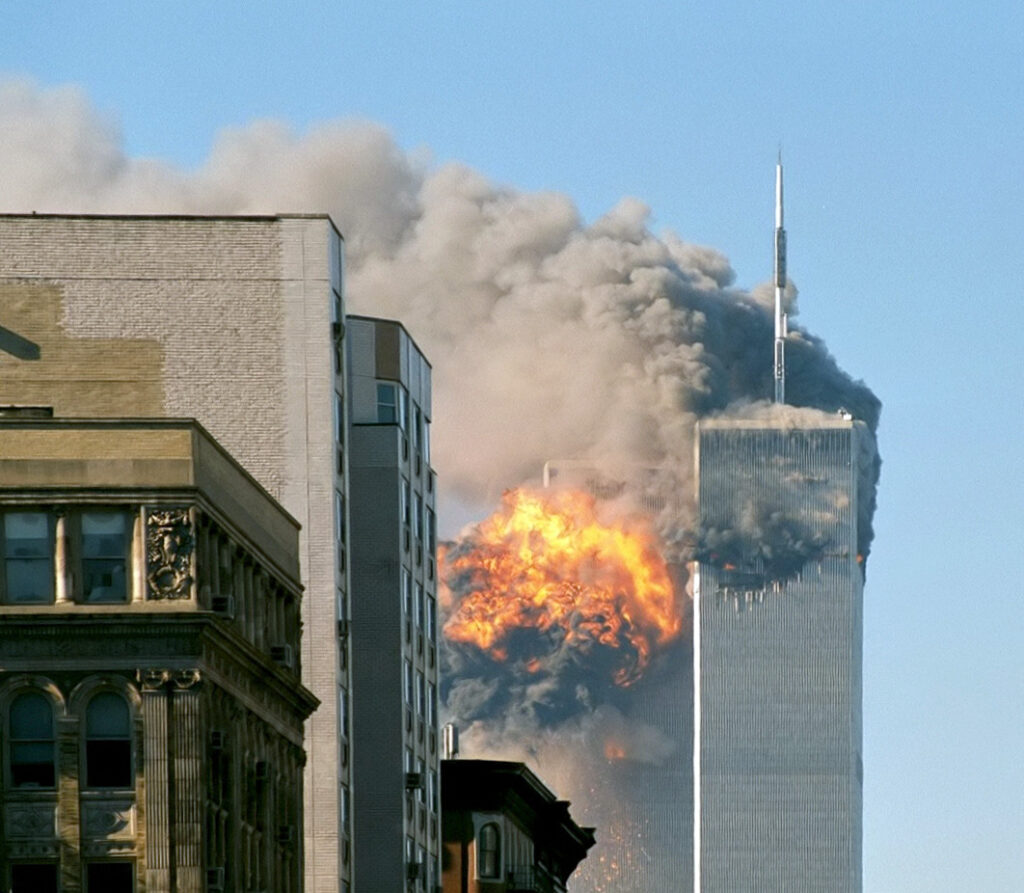
It’s been twenty-five years since 9/11. Twenty-five years is a long time, a quarter of a century, long enough for my babe-in-arms and toddler – who sat with me and ‘watched’ the horror unfold on tv – to reach adulthood. The significance of that day cannot be underestimated, it changed the world. My children’s generation grew up in the shadow of 9/11, in a world of foreign wars and terror.
Turning Point – Generation 9/11, a Netflix documentary, directed by Brian Knappenberger, released in advance of this gruesome 25th anniversary, takes the impact of the attacks on the post-9/11 American generation as its premise. Although not without its faults, notably the lack of background as to why America may have been targeted, the film makes for interesting viewing. It brings home the point that these acts of terror led to a seismic change in how Americans view the world and themselves. As with my own, now adult children, the lives of young Americans have been dominated by foreign wars, fear of terrorism at home and a rise in racism and Islamophobia. And US governments, one after another, have sought to capitalise on their fears.
The opening scene of the 90 minute film cover the attacks themselves, which have lost none of their power to shock over these 25 years. Eye witness testimony, recordings of 911 calls and calls to loved ones from inside the towers include some footage I certainly hadn’t seen before and makes for disturbing viewing/listening. The editing gives a sense of how the day itself played out. It really did feel like I was watching events fold out in real time. The initial shock of the first plane hitting the North Tower is palpable, yet the stunned commuters and news teams, on the ground within minutes, give no consideration to it being a deliberate attack. The realisation comes to the tv anchors and passersby, recorded live on air, when the second plane hits the South Tower 17 minutes later. That moment, which ended the lives of three thousand American civilians also, in Knappenberger’s judgement, ended the era of American innocence.
The film moves on to explore the impact of the day through the eyes of children who lost parents and young people whose lives were directed by subsequent events, mainly the invasion of Afghanistan. It explains how 9/11 shaped the chaos and division seen in America today.
Within just days, legislation was passed that gave the president powers to justify military action against any perceived threat – powers still in use. The ‘truther movement’ unleashed in the wake of 9/11, boosted by the Iraq war and lies of WMDs, undermined previously trusted institutions. Muslim Americans, who pre-9/11 felt welcomed and part of American society, were scapegoated. Trump’s demand for a wall and his Muslim ban are linked back to the terror attacks, with footage of a Trump rally showing how directly these links are made.
The Department of Homeland Security grew out of 9/11, as did the Immigration and Customs Enforcement agency (ICE). Recent footage of violent state repression illuminates how the fear of foreign terrorism has been used by politicians to reduce democratic freedoms and increase control over internal dissent.
This violence unleashed by the American state was of course not confined to home. America’s ‘forever wars’ began immediately following 9/11. Congress passed the 2001 Authorisation for Use of Military Force (AUMF) within a week of the attacks, with only one member voting against. AUMF has been used by one president after another to embark on conflict abroad: drone warfare, targeted assassinations, indefinite detentions (Guantanamo opened within months in January 2002) and military interventions. The film points out the US constitution requires Congress to declare war, but AUMF allows the president to determine military interventions which look, sound and are conducted as if it has. Officially the US is not at war with Iran, but try telling that to the Iranians. Knappenberger, although clearly not a supporter of US foreign policy, suggests the ‘War on Terror’ was an act of revenge, intended to prevent further foreign acts of aggression, true, but he ignores the history of American imperialism and the influence the Project for the New American Century played in post 9/11 planning. Condoleezza Rice’s now famous remark to senior officials in the National Security Council about how to ‘capitalise’ on the ‘opportunities’ 9/11 offered was not mentioned. Nevertheless, with insight rarely seen on mainstream tv, the question of whether US action has increased rather than decreased terrorism was posed.
The film, which opens with the attacks on America, closes with the disastrous evacuation from Kabul. It highlights how ill equipped the military personnel were and draws parallels with the fall of Saigon. The 20 years war in Afghanistan – the longest in both Afghanistan and US history – was a catastrophic defeat. In interviews with veterans of the evacuation the disillusionment is apparent among soldiers, not even born when the war they were sent to end began. In one scene a young soldier shows a map of Afghanistan changing colour as the Taliban advances, and questions what was it for.
The lack of attention in the film to the millions of Iraqis and Afghans who died in the post 9/11 wars undermines some of its punch. Indeed almost no attention is given to the Iraq war. The absence of the ‘collateral murder’ video released through WikiLeaks was in my view a mistake. However, the film does tell the story of a young American journalist who exposed the extent of the collateral damage of ‘precision’ drone attacks in Afghanistan (31 times more than officially recognised), and there is a heartbreaking story of an Afghan veteran separated from his wife in the chaos at Kabul airport – she is still in Afghanistan with little hope of being allowed to enter Trump’s America, while he and their two small children escaped.
The film ends with a message of hope, vested in the 9/11 generation. The fear and suspicion generated post 9/11 should, like the attacks themselves, be consigned to history. As such Knappenberger dreams that the next generation will forge a new chapter. For all our sake, I hope he’s right.